Coffee Tables · 13 min read
Coffee Table Shapes: Round, Rectangular, Square and Oval
 Donald Martin
Coffee table shapes come down to two measurements, not taste. Round wins in small rooms and busy walkways. Rectangular wins in front of a long sofa in a room at least 12 feet wide. Square wins with deep sofas and L-shaped sectionals. Oval is the compromise when you need surface area and clear passage at once.
Finish, base and storage are preferences. Shape is a math problem, and the two variables are the sofa the table faces and the path people walk to get past it. Get them wrong and you will bark a shin every day for a decade. Below: all four shapes, the room and household each one suits, where each one fails, and the shape we would pick for seven common living rooms. If you are earlier in the process, start with our complete coffee table buyer's guide and come back to settle the silhouette.
The Short Answer: Match the Shape to the Sofa and the Walkway
Get the two clearances first. Everything follows from them.
The gap between the sofa and the table. According to Povison's guide to coffee table spacing, the standard range is 14 to 18 inches from the front edge of the seat cushion, with 16 to 18 inches preferred in most homes. The same guide narrows that to 12 to 14 inches in small living rooms and widens it to 18 to 24 inches for deep sofas and sectionals, because a deep seat takes more room to get out of.
The walkway around it. Povison advises 24 to 30 inches of clearance on traffic paths near the table, and 30 to 36 inches on broader room layouts. Casagear's coffee table sizing guide sits at the lower end, telling readers to always keep at least a 24-inch walkway between the table and nearby furniture and to plan a 24 to 30 inch open aisle. General circulation guidance runs higher: VBU Furniture's walkway guide puts a primary route at 36 inches, where two people pass without turning sideways, and calls 30 inches the practical minimum, which still works but goes single file. The sources disagree by about six inches, so treat 24 as the hard floor for a secondary path and 30 to 36 for the route everyone actually uses.
The proportion. Povison puts the table at one-half to two-thirds the length of the sofa, with the top level with the seat height or 1 to 2 inches lower. Casagear frames the same idea as the two-thirds rule, and its sizing chart pairs a 97-to-110-inch sofa with a 64-to-72-inch table; run the same ratio down and a 90-inch sofa calls for a table around 60 inches long. In Livingetc's round-versus-square explainer, designer Alla Yaskovets of O and A London goes lower, suggesting roughly half the couch's length. So the honest range is half to two-thirds — the low end in a small room, the high end in a large one.
Rectangular Coffee Tables: The Default, and Where It Fails
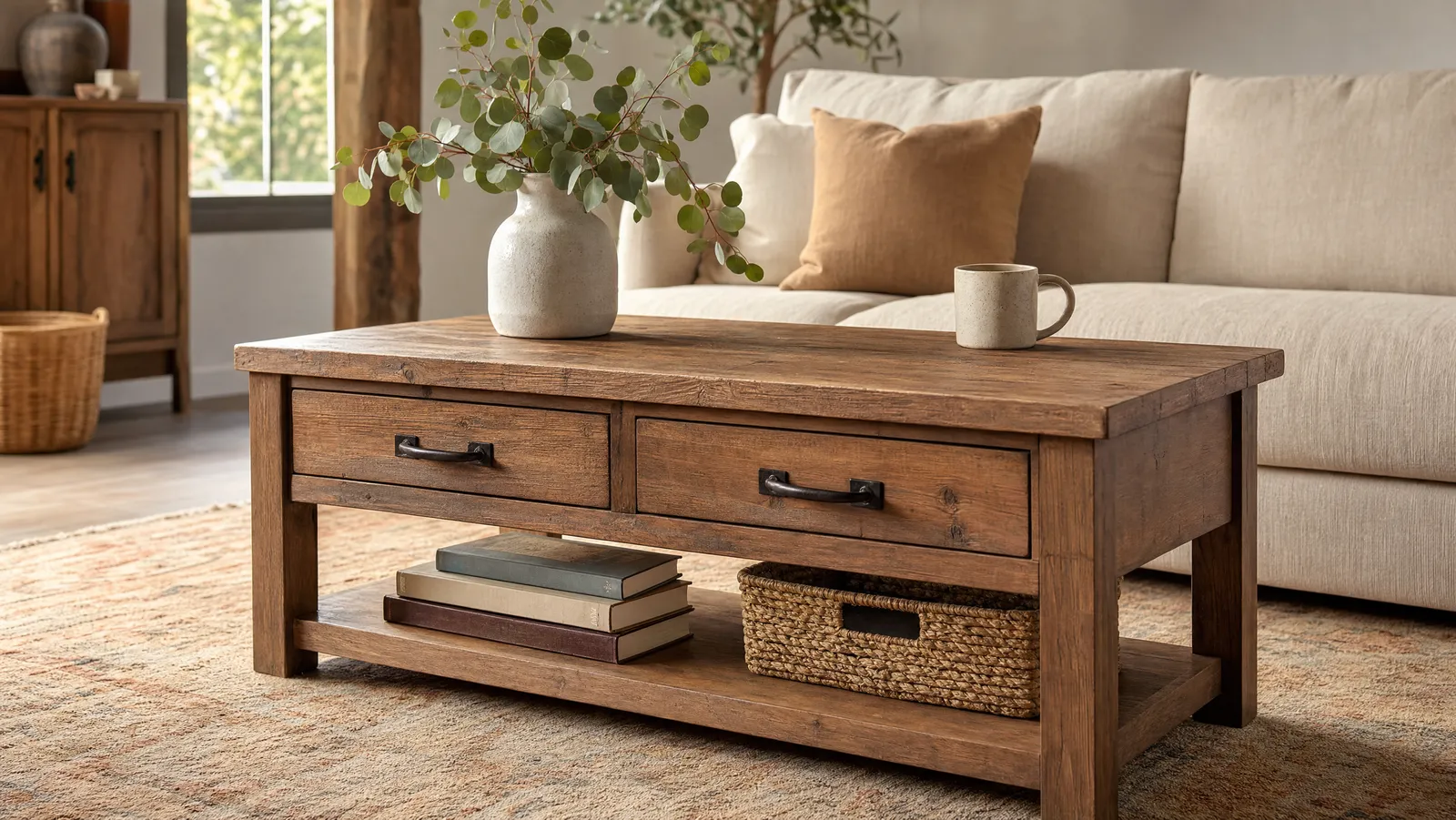
A rectangle is the default for one honest reason: it mirrors the sofa. A three-seat sofa is a long horizontal object, and a long horizontal table in front of it reads as deliberate rather than accidental. In Livingetc's piece, designer Nishtha Vashist says rectangular tables suit larger spaces and offer greater surface area, which helps for entertaining or displaying things.
Who they suit:
- Long sofas. At two-thirds, an 84-inch sofa wants about 56 inches of table and a 90-inch sofa about 60. Only a rectangle gets that long without becoming absurd in the other direction.
- Rooms 12 feet wide or more. A rectangle needs depth in front of the sofa, and a narrow room does not have it.
- Households that use the table. Laptops, board games and takeout for four want a long flat run of surface.
- Rectangular sectionals. According to Rove Concepts' shape guide for sectionals, square and rectangular tables work best with square or rectangular sectionals, creating what it calls a cohesive and visually pleasing look.
Where they fail:
- Narrow rooms. A 20-inch-deep rectangle plus a 16-inch gap plus a 30-inch walkway needs 66 inches of clear floor in front of the sofa. An 11-foot room with a media unit opposite may not have it.
- Traffic paths. Four corners at exactly shin height, sitting in the one route everyone walks.
- Conversational groupings. With a sofa and two facing chairs, a rectangle points its short ends at the chairs.
Rectangular is still right more often than any other shape. It just punishes a room that cannot accommodate it.
Round Coffee Tables: Small Rooms, Corners and Toddlers
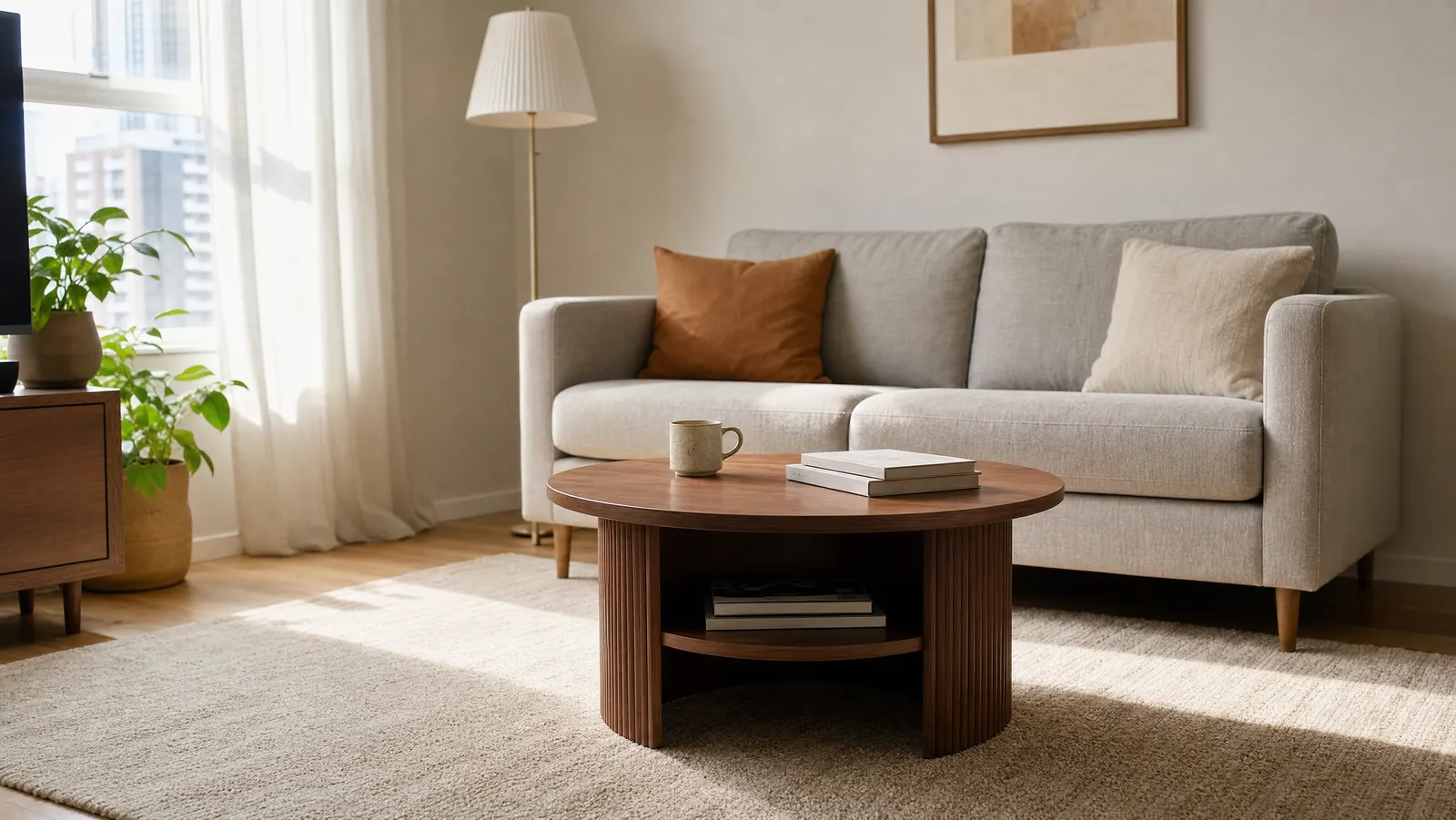
Round is what we recommend for a small living room, and the reason is not aesthetic. Circles have no corners to walk into, and people curve around them instead of stopping and redirecting.
The designers in Livingetc's piece are unusually unanimous. Jane Lockhart of Jane Lockhart Design says a round table in a small living room will open up the flow and is easier to navigate without bumping your shins. Nishtha Vashist says round tables work well in smaller or irregularly shaped rooms, promoting a more fluid and open feel while reducing sharp corners for safety.
Sizing. According to Petalwood Interiors' guide to coffee table shapes for small spaces, a standard round coffee table measures 75 to 90 centimetres in diameter — roughly 30 to 35 inches. Unfnshed's round table size guide breaks that down by room: about 24 inches for a studio or a bedroom seating area, 28 to 30 inches for small living rooms and apartment main spaces, and 32 to 36 inches for a standard living room with an open floor plan.
The trade-off nobody mentions: you lose usable surface. A 36-inch round top is roughly 1,018 square inches; a modest 48-by-24-inch rectangle is 1,152. The far arc is also out of reach from the seat, so it ends up holding a plant.
Where round fails: in front of a long sofa in a large room. A 36-inch circle facing a 90-inch sofa reads undersized — exactly what the two-thirds rule predicts.
Square Coffee Tables: Deep Sofas, Sectionals and Square Rooms
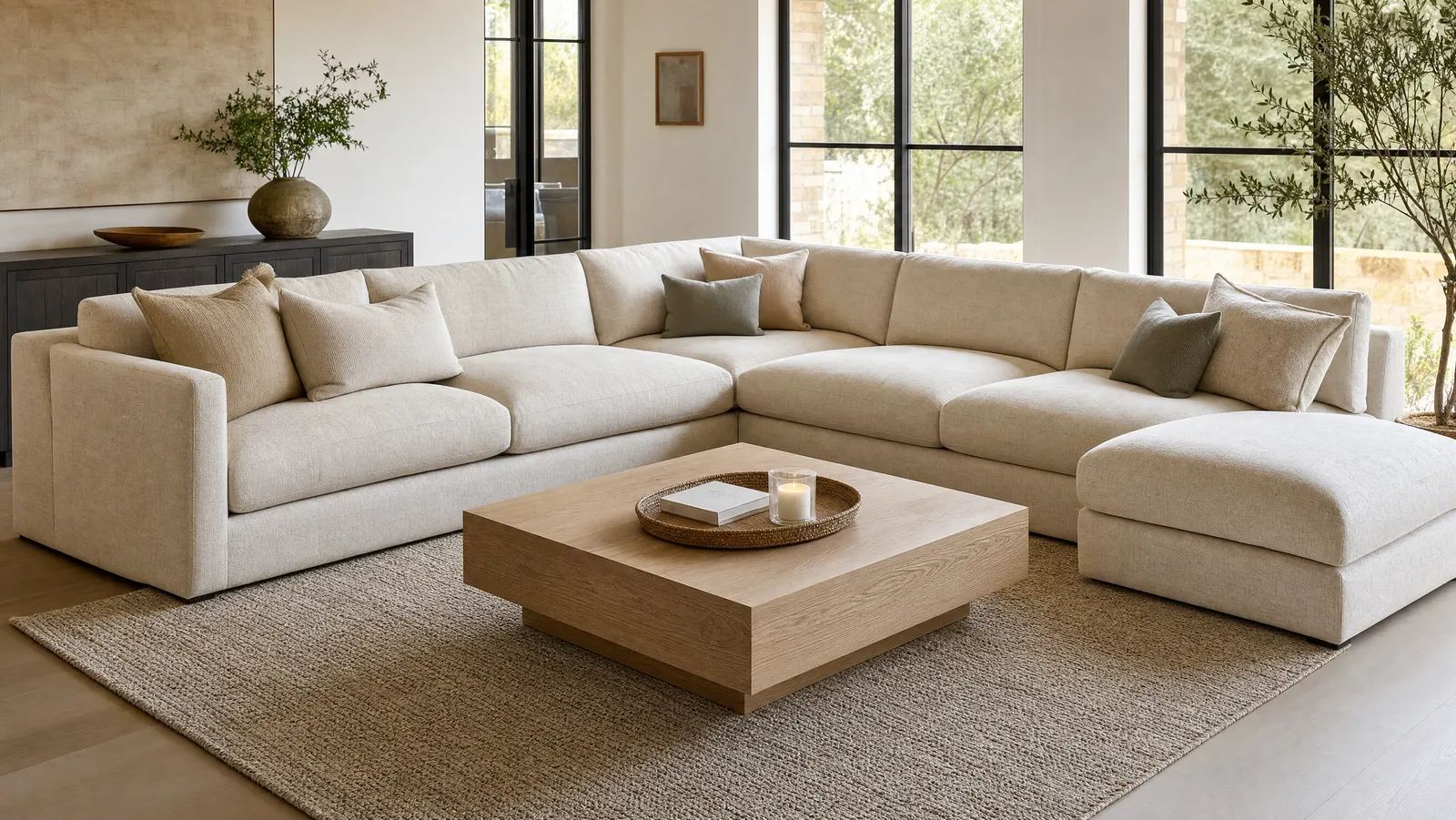
The square is the shape most people skip and then wish they had bought. Its case is specific: it works when seating wraps around more than one side of it.
- L-shaped sectionals. With seating on two adjacent sides, a square gives equal reach to both runs. Rove Concepts recommends square and rectangular tables for square and rectangular sectionals for precisely this reason.
- Deep sofas. A deep seat pushes people back, so the table needs depth too. A 36 to 40 inch square stays reachable from a seat you have sunk into; a 20-inch-deep rectangle leaves you stretching.
- Square rooms. With seating on two or three sides of a near-square room, a square table is the only shape that does not fight the geometry.
Where it fails: in front of a standard 84-inch sofa in a normal room. A 40-inch square is under half the sofa's length, so it reads small, and it eats depth in the direction a narrow room cannot spare — with the same four shin-height corners as a rectangle and none of the visual excuse. For chaise placement specifically, see our upcoming guide to the best coffee table for a sectional.
Oval Coffee Tables: The Compromise Shape
An oval is a rectangle with the corners taken off, and that is the whole argument: you keep most of the length and lose every corner, which is why we reach for it in a room people walk through. According to 2Modern's guide to coffee table shapes for sectionals, an oval's curved edges help soften the angles of a sectional, and ovals tend to work well in smaller spaces where a rectangular table would feel too overwhelming. Rove Concepts recommends round or oval shapes for curved sectionals for the same reason.
Buy an oval when these are true:
- A walkway runs past or through the seating. This is the shape we would pick for a living room you cross to reach the kitchen.
- The sofa is long enough that a circle would look lost. An oval runs 48 to 60 inches without a single corner.
- Something curved is already in the room — a curved sofa, an arched doorway, a round dining table — for the oval to answer.
- Small children live there. More below.
The downsides are real. Ovals are the least common of the four shapes, so selection is thinner and prices run higher for equivalent quality. They also do not tuck flat against a wall or a sofa back the way a rectangle does. And in a strictly rectilinear room with a squared-off sofa, an oval can read as indecisive rather than soft.
Shape and Room Size: What Actually Fits
Do this arithmetic before you shop. It takes two minutes and eliminates half the catalog.
Measure from the wall behind the sofa to the wall or media unit opposite. Subtract the sofa's depth and the depth of anything against the far wall. That is your working span. Now remove the sofa-to-table gap and the walkway.
A worked example. An 11-foot room measures 132 inches wall to wall. A 38-inch-deep sofa and an 18-inch-deep console take 56 of those, leaving 76 inches. Allow 16 inches of legroom and 30 inches of walkway and you have 30 inches of table depth. That comfortably fits a rectangle at the usual 18 to 24 inches deep, and technically fits a 30-inch round only by consuming every spare inch — though a round table's curve gives some of the walkway back, which is why a 30 to 32 inch round often feels better in that room than the numbers suggest.
Two rules cut across all four shapes:
- The table should sit fully on the rug, not half on and half off. In a standard living room that usually means an 8-by-10 rather than a 5-by-7. Our guide to stylish rugs for the living room covers the sizes that let a sofa and coffee table share one rug, and how to place an area rug walks through the front-legs-on layout most rooms need.
- Height beats shape for comfort. Keeping the top level with the seat or 1 to 2 inches below it, as Povison advises, matters more day to day than whether the top is round or square. We break the numbers down in our guide to coffee table size and height.
Shape and Household: Kids, Pets and Sharp Corners
Here shape stops being decorative. The evidence is thinner than you would expect, but it points one way.
The foundational study is old. A 1985 review of injuries involving household furniture, published in Pediatric Emergency Care and indexed on PubMed, reported roughly 250,000 furniture-related injuries in the United States in 1982, a quarter of them attributed to coffee tables. Most were lacerations of the head and face, and in the authors' review of injured children presenting to the emergency department, square or rectangular coffee tables with sharp edges were usually involved.
Recent surveillance confirms the age profile without singling out a shape. A study of pediatric craniofacial furniture accidents using the National Electronic Injury Surveillance System, published in the International Journal of Pediatric Otorhinolaryngology, examined 2013 to 2022 data and found 1,696 cases representing an estimated 41,914 emergency-department injuries nationally, with a mean age of 3.9 years and most injuries in toddlers aged 1 to 3. That is exactly the age at which a child's head is level with a coffee table edge.
Be clear about what this does and does not prove. We found no study comparing injury rates between round and rectangular tables in matched homes, so treat "round is safer" as informed design consensus rather than a measured result. The consensus is strong, though. Emily Henderson's team, in their guide to kid-friendly coffee tables, tells readers to avoid sharp hard corners and look for silhouettes that are a little more rounded, to say no to glass entirely on a pediatrician's advice, and to skip lightweight tables that tip. Their preferred answer is an upholstered ottoman, which they call probably your safest bet when it comes to avoiding potential trips to the emergency room.
We agree, with one caveat: an ottoman needs a tray to become a table. If that trade sounds worth it, our roundup of stylish ottomans for the bedroom and living room covers the sizes and upholstery that survive daily use. Otherwise buy round or oval, buy heavy enough that a toddler cannot drag it, and skip glass. Pets push the same direction: a wagging tail sits at table height and finds corners.
Two Small Tables Instead of One
The shape question has a fourth answer catalogs rarely present: do not buy one table.
Two smaller surfaces solve what a single large one cannot. They pull apart for a crowd and push together for a movie, and they leave real walking gaps instead of forcing traffic around one long obstacle.
Nesting tables are the tidiest version. According to Apartment Therapy's roundup of nesting coffee tables for small living rooms, they deliver more surface area in a smaller footprint and are considerably more flexible than a standalone piece, because you expand or contract the surface on demand.
When we would do it:
- In front of a long sectional, where one table cannot serve both runs. Two rounds, one per seating leg, beats a single rectangle stranded in the middle.
- In a room you rearrange often — a studio, a rental, a room that hosts.
- When the walkway is the real problem. Two 24-inch rounds with 18 inches between them make a gap a person can step through. A 54-inch rectangle does not.
The rule that keeps it from looking like leftovers: keep the tops within about two inches of the same height, and let the pieces differ in material or diameter, not both. We compare stone, wood, glass and metal in our coffee table materials comparison.
Which Coffee Table Shape We Would Choose
By scenario, with no hedging:
- Standard sofa, room 12 feet wide or more: rectangular, at two-thirds the sofa length. It is the default because it is usually right.
- Small living room, apartment or studio: round, 28 to 32 inches. The shin clearance is worth the lost surface.
- L-shaped sectional with square lines: square, 36 to 40 inches, so both runs of seating get equal reach.
- Curved sofa or curved sectional: round or oval, following the seating.
- A living room you walk through to get somewhere else: oval. It is the only shape offering rectangle-scale surface with no corner in the path.
- Toddlers in the house: round or oval, heavy, no glass — or an upholstered ottoman with a tray.
- Very long sofa in a large room: two tables, not one. A pair of rounds covers more of the sofa's length than any single piece at a sane size.
When two scenarios conflict, let the walkway win. Surface area is a convenience a side table can supplement. A blocked path is a daily irritation you cannot fix without moving furniture.
The Bottom Line
Coffee table shape is not a style choice dressed up as a practical one. Measure the span between your sofa and whatever faces it, subtract 14 to 18 inches of legroom and 30 inches of walkway, and the depth left over tells you which shapes are even candidates. Apply the proportion rule — half to two-thirds the sofa's length — and the field narrows to one or two.
Our default is rectangular in a room with space for it, round in one without, square in front of a sectional, oval wherever people walk past. With small children, move one step toward the curve.
For the rest of the decision — height, size, material, base and storage — picking a coffee table covers the whole process in one place. Shape is the constraint you solve first, because it is the one your room decides for you.
The Author
About the author
Interior Designer
Donald Martin
Designer since 2006 and a lifelong lover of rescued objects, Donald Martin knows how to give a second life to pieces and weave them into an eclectic, personalized interior. He writes about decorating real homes on a real budget.