Dining Room · 21 min read
How to Choose a Dining Table: Size, Shape, Height and Materials
 Donald Martin
The Short Answer
Choose a dining table in this order: measure the room, subtract 36 inches of clearance on every side a chair pulls out, and whatever rectangle or circle is left is your maximum table. Then pick the shape that suits the room's proportions, confirm the height at 30 inches, and choose a top you will actually maintain.
Some links below are affiliate links; if you buy through them we may earn a small commission at no extra cost to you.
Everything else — pedestal or four legs, bench or chairs, extendable or fixed — follows from those four decisions. This guide covers how to choose a dining table in that order, with the arithmetic written out rather than described, and ends with the six tables we would buy.
What Size Dining Table Fits Your Room?
Start with the room, not the table. Measure the length and width of the dining area, subtract 72 inches from each dimension, and what remains is the largest top the room can carry.
That 72 inches is 36 inches of clearance on each side. According to the dining table size guide at The Furniture Mall, you should maintain a minimum of 36 inches between the table and walls or other furniture, and the Joon Loloi sizing guide gives the same figure: enough to pull a chair out and still move around the table.
Run it on a real room. A dining area of 12 by 10 feet, which is 144 by 120 inches, leaves 72 by 48 inches of usable tabletop — a generous six-seater. A 10 by 10 foot room leaves 48 by 48 inches, which means a square or a 48 inch round, not a rectangle for eight. The room decides this, and it is not negotiable.
Then sanity-check the top itself. According to Castlery's guide to key dining table measurements, a width of 36 to 42 inches is common for rectangular tables, and most sizing guides treat 42 inches as the minimum width before you can put chairs at the ends, with 48 inches more comfortable. On length, the same Furniture Mall guide puts a 6 foot table at six to eight people and an 8 foot table at eight to ten.
Two habits worth keeping. Tape the footprint onto the floor in painter's tape and live with it for a day before you order anything. And if you would rather not do the subtraction by hand, our home design calculators will run it for you. We go deeper on what size dining table fits your room in a dedicated guide, but those two subtractions settle most of it.
Round, Rectangular, Oval or Square?
Shape follows the room's proportions and the way people move through it, not your preference for a silhouette.
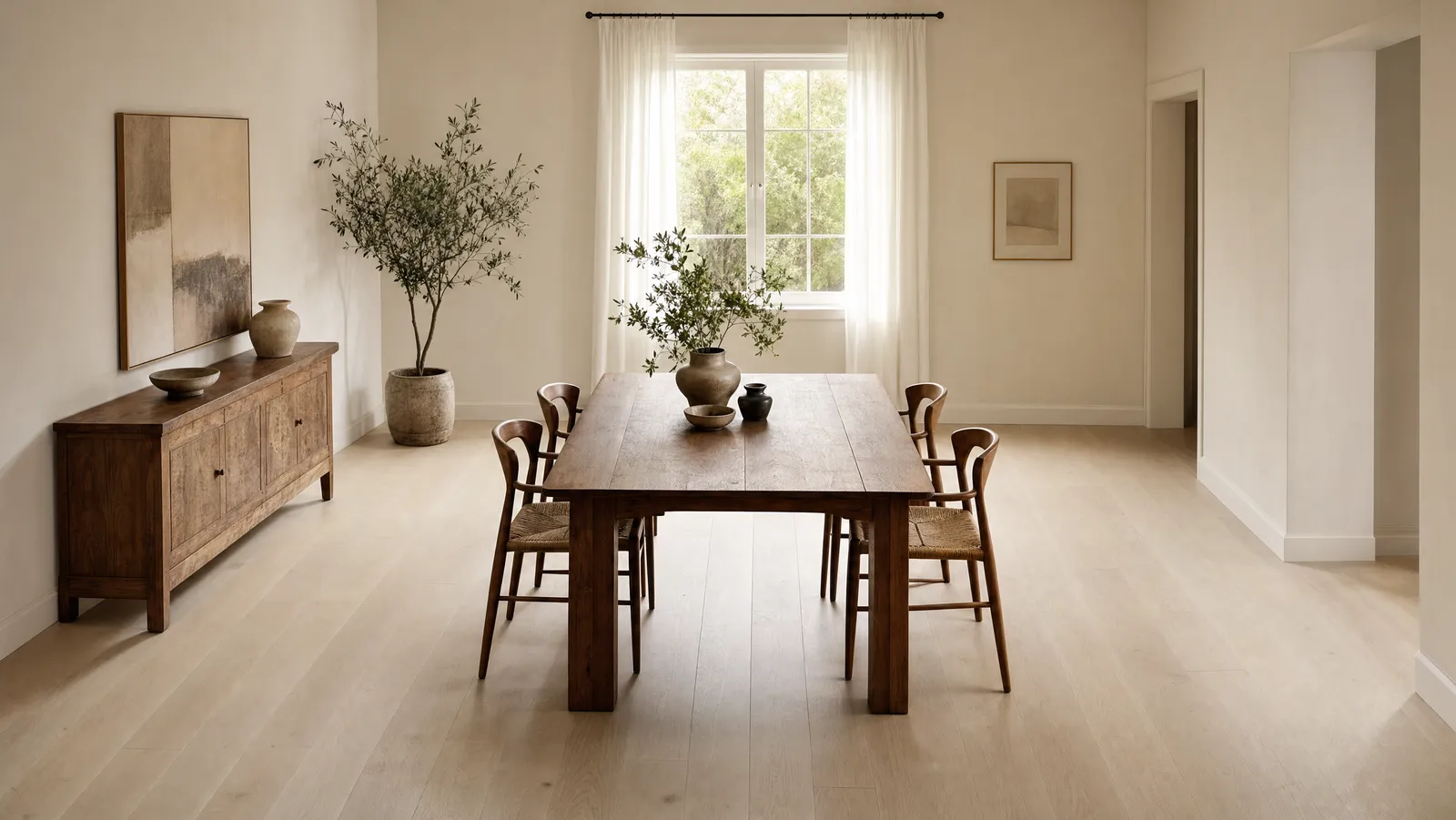
- Rectangle. The default, and the right answer for a long room. It yields the most seats per square foot of floor and it is the only shape that scales past six without becoming enormous. The cost is four corners and, on a four-legged table, four legs that land exactly where the end diners want their knees.
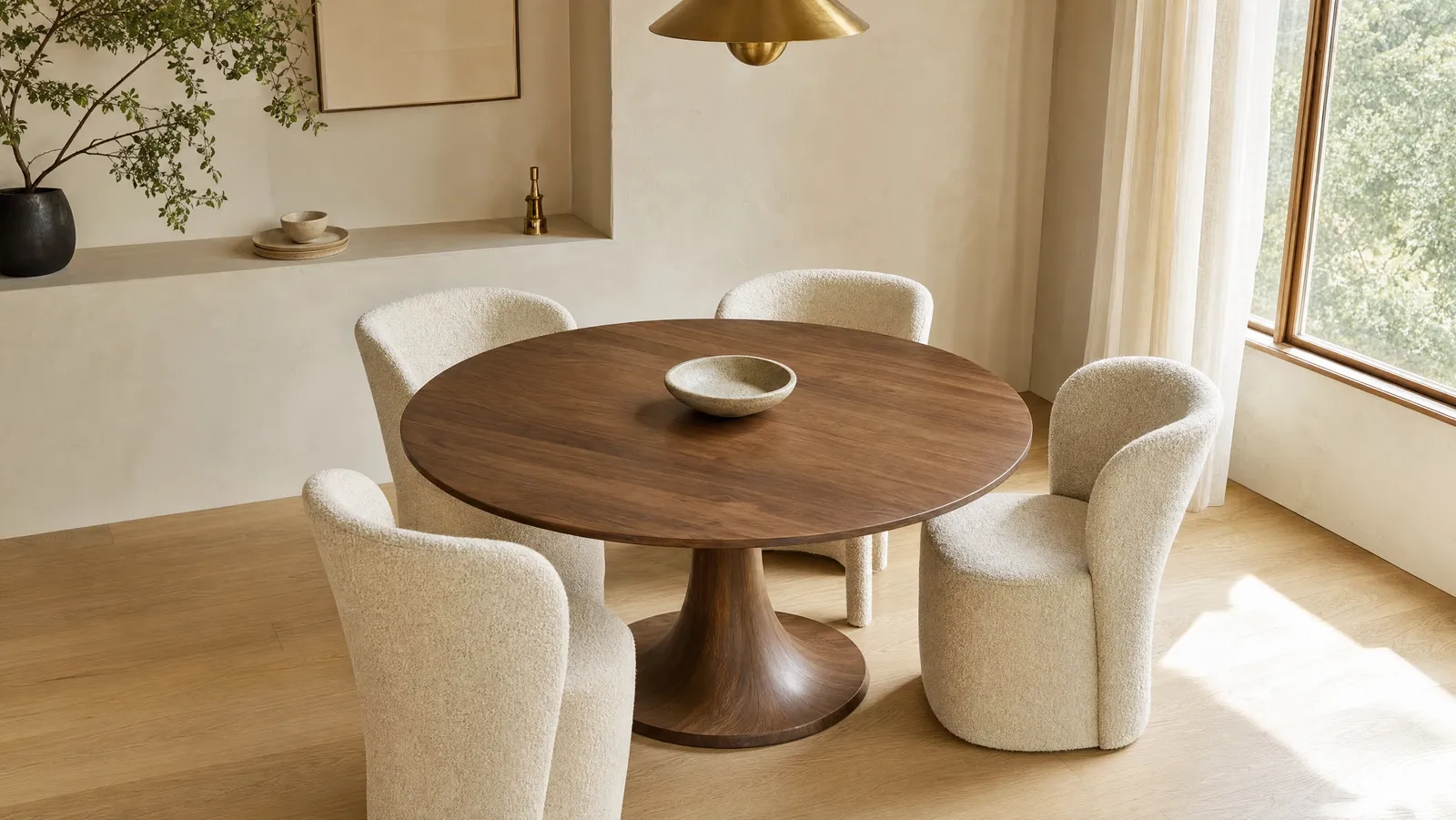
- Round. Best in a square or narrow room, and best for conversation, because every seat faces every other seat. A circle also has no corner to catch a hip in a tight walkway. The cost is capacity: edge length grows slowly as diameter grows.
- Oval. A rectangle with the corners taken off. You keep most of the length and lose the shin hazard, which makes it the shape to look at when a long room has a pinch point at one end.
- Square. For square rooms and households of four. Four people at a 48 inch square each get a full side and nobody sits at a corner. Past four it stops working.
The base matters as much as the outline. A pedestal or a double pedestal lets chairs slide anywhere along the edge; a four-legged table fixes where the end seats can go. Both our 47 inch round and our 71 inch rectangle are pedestal designs for exactly that reason. We put dining table shapes compared side by side in a separate article, but the short version is this: buy a rectangle if the room is long, a round if the room is square or small, and an oval if you want both.
Standard Dining Table Height
Thirty inches, and then you can stop thinking about it.
According to the dining table height guide at Living Spaces, standard dining tables are typically 28 to 30 inches tall, and the Joon Loloi sizing guide gives the same 28 to 30 inch band. Thirty inches is the top of that band and the figure we default to. That is why chairs are interchangeable at all, and it is why both rectangular tables we recommend below measure 30.12 and 29.5 inches.
What actually varies is the band you choose. According to Sebring Design Build's table height guide, counter-height tables measure 34 to 36 inches and pair with stools 24 to 26 inches tall, while bar-height tables run 40 to 42 inches and take stools 28 to 30 inches. Those three bands do not mix. A 24 inch stool pulled up to a 30 inch table puts a diner's chin near the plate, and a dining chair at a counter-height table leaves them reaching up for the salt.
Two numbers go with the table height. Per the same Sebring guide, dining chair seats for a standard table sit 17 to 19 inches off the floor, and most sizing guides, the Castlery measurements above included, want 10 to 12 inches between the top of the seat and the tabletop. Measure the underside, not the top, because a thick apron or a deep skirt can eat two or three inches of that gap without changing the published height at all. We cover standard dining table height, stool pairing and apron clearance in more detail elsewhere in this series.
Table Top Materials Compared
Material decides what the table looks like in ten years. It is also where price differences are real rather than cosmetic.
- Solid wood. The only top that can be repaired. A scratched oak surface sands and refinishes; nothing else on this list does. The trade-offs are cost, weight, and movement — solid wood expands and contracts with humidity.
- Veneer over a stable core. A thin layer of real wood over MDF or particleboard. According to Room and Board's wood guide, engineered panels offer high resistance to the expansion and contraction that changing temperature and humidity cause in solid wood, which is why they are used as the base under a veneer. The weakness is the surface: once you cut through the veneer, there is nothing underneath to refinish.
- MDF and engineered panels. Stable, smooth, and the reason a good-looking table can cost under 150 dollars. Moisture is the enemy, so the finish is the product. Our budget and small-space picks both use sealed, waterproof-rated tops for this reason.
- Stone and sintered surfaces. According to Coleman Furniture's guide to durable kitchen tables, sintered stone is non-porous and scratch-resistant and takes a hot dish without a trivet. A chip, however, cannot be repaired. Marble is the opposite trade: beautiful, porous, and prone to staining and etching from wine and lemon.
- Glass. Visually weightless, which is why it works in a small room, and completely unforgiving about fingerprints. Dining glass is tempered, which is designed to make it break into small blunt pieces rather than long shards; tempering does not make it unbreakable.
Style follows from this more than people expect. If you want a warm, worn, lived-in dining room, a wood or wood-look top is doing most of that work — our guide to farmhouse dining room decor shows how the rest of the room follows. We rank dining table materials compared on durability, repairability and upkeep in a dedicated article.
Clearance, Walkways and Door Swing
Clearance is the number people skip, and it is the one that ruins rooms.
Use 36 inches as the minimum on every side where a chair pulls out, per the figures above. Dimensions.com's dining room clearances break that number into its two parts: a sitting zone of 18 to 24 inches for the chair and the person in it, plus a circulation zone of 18 to 36 inches behind it, for a combined 36 to 60 inches. Where people will actually walk behind seated diners, go to the top of that range. The Lumber Shack's round table buying guide recommends 42 to 48 inches between the table and the walls for that reason.
Then walk the room with a tape measure and check three things the catalogue will not tell you:
- Door swing. An inward-swinging door needs its full arc clear of a pulled-out chair, not just clear of the table.
- Cabinet and appliance doors. In a kitchen-dining room, an open dishwasher or oven door is a second clearance zone. Measure it open.
- The one side nobody uses. A table pushed to a wall or a banquette only needs clearance on three sides, which can buy you a foot of table length.
The rug belongs in this calculation, not after it. According to Revival Rugs' guide to rug sizes under a dining table, a dining rug should extend at least 24 inches beyond every side of the table so chairs stay fully on it when pulled out, which in practice means adding 48 inches to the table's length and width. Set that against the 18 to 24 inch sitting zone above and 24 inches is the floor, not the target. Work out what size area rug you need before you commit to a table length, and read how to place an area rug if the dining area sits inside a larger open-plan room. We treat dining table clearance and placement, including banquettes and open-plan zoning, in its own guide.
How Many Chairs Will It Seat?
Ignore the listing's seat count and do the arithmetic yourself. According to the Joon Loloi dining table sizing guide, the general rule is 24 inches of table space per person for comfort.
For a rectangle, divide the length by 24 to get the seats per long side, then double it. A 70.87 inch top gives 2.95 per side, so three per side and six seats. Add the ends only if the top is at least 42 inches wide, which rules out both of the rectangles we recommend below — they are 35.43 and 31.5 inches wide, so six is six.
For a round table, multiply the diameter by 3.14 and divide by 24. The results are clarifying:
- A 42 inch round gives about 132 inches of edge, or five and a half places. Four people are comfortable; six is a squeeze.
- A 46 inch round gives about 144 inches, which is six places at exactly 24 inches each.
- A 47 inch round gives about 148 inches, so six at a casual meal and five at a formal one.
- A 60 inch round gives about 188 inches, or seven to eight by the arithmetic, though The Lumber Shack puts six to eight people at 72 inches of diameter or more.
Published seat counts usually assume nobody has elbows. Where a listing says four to six, read it as four for a long dinner and six for a quick one. We work through how many chairs fit a dining table, including head-of-table geometry and bench seating, in a separate piece.
Bench or Chairs?
A bench changes the arithmetic, not just the look.
The case for a bench is clearance. A bench slides fully under the table when nobody is sitting on it, so the side it serves does not need the full 36 inches behind it — which is how a 70 inch table fits a room that measured too small for one. A bench also ignores the 24 inch rule: three children fit on a 60 inch bench where three chairs would not fit on a 60 inch side. And it reads lighter, because you see the floor under it instead of four chair backs.
The case against is comfort and access. No back support makes a two-hour dinner hard work for adults, and everyone on a bench has to get up when the person in the middle wants to leave. A bench pushed against a wall compounds that.
What we actually recommend: a bench on one long side and chairs on the other, with chairs at the ends if the top is wide enough. You get the clearance win on the wall side, proper back support for the people who want it, and a room that does not look like a furniture set. Buy the bench two to four inches shorter than the table's length so it tucks in cleanly rather than catching the legs. We make the full case for a dining bench instead of chairs, with sizing rules, in its own article.
Dining Table or Kitchen Table?
The labels are mostly marketing, but three real differences hide behind them.
Height band. A dining table is 30 inches. A kitchen table is often counter height at 34 to 36 inches to line up with the island or peninsula, per the Sebring Design Build figures above. If the table sits beside a counter run and you want one continuous surface, counter height is the deliberate choice — just buy the stools at the same time, because 24 to 26 inch stools are not interchangeable with dining chairs.
Surface tolerance. A kitchen table absorbs homework, laptops, hot pans and craft projects. That argues for a sealed, wipe-clean top rather than a marble or an oiled timber you will be nursing. Both of our round picks under 100 dollars list a heat-resistant, scratch-resistant, waterproof top and our 70.9 inch rectangle a waterproof, easy-to-clean finish, which is not a coincidence.
Formality and footprint. A dedicated dining room can carry a 71 inch rectangle and eight chairs. A kitchen eat-in area usually cannot, and a 42 to 47 inch round will serve it better while leaving the work triangle intact.
If you only have room for one table, buy the kitchen version of the decision: standard 30 inch height so chairs stay interchangeable, a top you can wipe without thinking, and a pedestal base so chairs land wherever they need to. We compare dining table vs kitchen table on height, durability and layout in its own article.
Extendable and Drop-Leaf Tables
An extendable table is a bet that your worst-case dinner is rare. That is usually a good bet.
The three mechanisms behave differently:
- Butterfly or self-storing leaf. The leaf lives folded inside the table. Nothing to store in a closet, and the extension takes under a minute. The mechanism is the part that fails.
- Drop-leaf. One or both sides hinge down. At its smallest a drop-leaf sits against a wall like a narrow console; at full extension it seats four to six. Best space saver on this list.
- Separate leaf. Pull the halves apart and drop a loose panel in. Simplest and most durable, but the leaf has to live somewhere, and the seam shows.
The honest constraint is that extension does not create clearance. A table that extends to 90 inches still needs 36 inches behind the chairs at each new end, so measure the extended footprint, not the folded one. A drop-leaf against a wall is the exception, because the folded state is the daily state.
None of the six tables we recommend below extend. That is a real limitation, and if you host eight people more than a few times a year, buy an extendable table instead of our rectangle. We round up the best extendable dining tables, mechanism by mechanism, in a separate guide.
Small Rooms and Apartments
In a small room every inch of clearance is worth more than an inch of tabletop. Four moves get you a usable dining area in a space that looks too tight for one.
Go round, and go pedestal. A circle has no corner to walk into, and a pedestal or cross base means chairs tuck in from any angle rather than straddling a leg. A 42 inch round on a cross base needs a room about 114 inches square at full 36 inch clearance, or 102 inches square if you accept a tighter 30 inches all round.
Use the wall. Clearance is only needed where a chair pulls out. One side against a wall or a bench removes 36 inches from the requirement outright.
Buy storage into the table. In a small kitchen there is no sideboard, so a built-in shelf or a drawer is not a gimmick. Both of our round picks under 100 dollars have a shelf underneath, and our rectangle has two hidden drawers.
Keep the sightline open. A light top, a slim base, armless chairs and stools that disappear under the table all make the same room read larger. Glass does this best and asks the most in maintenance.
What we would not do is buy a 48 inch round because it seats six on paper when the room only clears 36 inches around a 42. We cover the best dining tables for small spaces, including drop-leaf and console-to-table designs, separately.
Why a Round Table Often Wins
If we had to recommend one shape without seeing the room, it would be round.
Three reasons. First, conversation: at a circle everyone can see everyone, where a long rectangle splits into two conversations. Second, circulation: there are no corners, so a round table in a traffic path costs less clearance than a rectangle of the same capacity and nobody catches a hip. Third, flexibility about seats — on a pedestal round, five people and seven people both work, because there are no fixed places and no legs dictating where a chair can land.
The numbers are friendlier than people expect at the sizes most homes need. According to Countryside Amish Furniture's guide to dining table seating capacity, a 48 inch round seats five comfortably for a formal meal and six for a casual one, and The Lumber Shack's round table guide puts 42 to 60 inches of diameter at four to six people. Our 47 inch pick sits right in that band.
Where round loses is scale. Past about 60 inches the middle of the table becomes unreachable, so a serving dish in the centre is decoration rather than dinner, and capacity grows slowly: going from 48 to 60 inches adds a foot of diameter and only about two seats. For eight or more, a rectangle or oval is the correct answer. We pick the best round dining tables by diameter and base type in a dedicated article.
Seating Six Comfortably
Six is the number most households actually want, and it has two correct answers.
A rectangle of 70 to 72 inches. At 24 inches per person that is three places per side with nothing wasted. Both rectangles we recommend are right there at 70.87 and 70.8 inches. Budget the room first: 70.87 inches plus 36 inches of clearance at each end means a dining area just under 12 feet long, and 35.43 inches of width plus the same clearance on both sides means about 8 feet 11 inches across.
A round of 46 to 48 inches. About 144 to 151 inches of edge, which is six places at 24 inches each. A 47 inch round plus 36 inches all round needs a room roughly 119 inches, or just under 10 feet, square. In a small or square room that is far easier to find than 12 feet of length.
Two details separate a comfortable six from a cramped six. Width: a rectangle narrower than about 36 inches leaves little room down the centre once two place settings face each other, so serving dishes move to a sideboard. And base type: a double pedestal or a single pedestal lets six chairs land anywhere, while a four-legged table forces two diners to negotiate with a leg. We shortlist the best dining tables for 6 on both shapes, with the clearance arithmetic for each, in its own guide.
The Dining Tables We Recommend
Six tables, each solving a different version of the problem. All prices are as of October 2026 and move around, so treat them as a snapshot.
If you need to seat six
The Jocoevol 70.9 inch industrial table is our overall pick at about 130 dollars as of October 2026, against a 175.99 dollar list price. The specification reads like the arithmetic in this guide: 70.87 inches long, which is three 24 inch places per side; 30.12 inches tall, which is dead on the residential standard; and a 3.23 inch thick top on a reinforced metal frame rated to 350 pounds, the sturdiest rating in this group. Two hidden side drawers hold napkins, placemats and cutlery, which matters because a kitchen eat-in area rarely has a sideboard. At 35.43 inches wide it will not seat anyone at the ends, and chairs are not included.
The Tribesigns 71 inch double-pedestal table, about 220 dollars as of October 2026, is the one to buy if six sometimes becomes eight. Two pedestals instead of four corner legs mean chairs slide anywhere along a 70.8 inch edge, which is the whole argument for it, and the 29.5 inch height is standard. It is 31.5 inches wide, though, so the centre of the table is narrow once two place settings face each other, and the 180 pound rating is the lowest here. It is MDF throughout.
If the room is small
The Alpen 42 inch round, about 97 dollars as of October 2026, is the smallest table here that still seats four properly. Its cross-shaped pedestal on reinforced 25mm metal legs is the right base for a tight room, because stools and chairs tuck fully underneath instead of straddling a leg, and the storage shelf underneath replaces the cabinet the kitchen does not have. Read the listed four to six as four for a long dinner.
The Jocoevol 46 inch round, about 98 dollars as of October 2026, is our budget pick and, for most people, the better buy of the two. For roughly the same money you get four more inches of diameter, and by the circumference arithmetic above those four inches are the difference between five and a half places and six. Same cross base, same shelf, same heat- and scratch-resistant waterproof top. The caveat is the same too: an MDF top is only as waterproof as its finish.
If you want round, done properly
The LITTLE TREE 47 inch round, about 203 dollars as of October 2026, is the round table we would buy if the budget allows. A solid wooden pedestal is the most chair-friendly base there is, and 47 inches of diameter is about 148 inches of edge, so six people get their 24 inches each - a casual six rather than a formal one, by the figures above. It costs roughly twice what the 42 and 46 inch rounds do and has no storage shelf, so you are paying for the base and the proportions.
If you want the room to look modern
The VASAGLE 55.1 inch table, about 100 dollars as of October 2026, is the most current-looking piece in the group: a rustic natural walnut top on splayed black steel legs. The top withstands heat up to 140 degrees Celsius and resists scratches, and swivel leveling feet correct for an uneven floor, which is a real benefit in an older home. The trade-off is substance. At 0.6 inches the veneered particleboard top is the thinnest here and the 220 pound rating is modest, so this is a table for four, generously, rather than six.
Conclusion
Measure before you shop. Subtract 72 inches from each dimension of the room, keep the height at 30 inches, allow 24 inches of edge per person, and the shortlist writes itself. Shape, base and material are preference; those three numbers are not.
For most homes our default is the 70.9 inch industrial rectangle: correct height, three places per side, hidden drawers, and about 130 dollars as of October 2026. Buy the 46 inch round instead if the room is square or tight, because six places on a 144 inch circumference beats a rectangle you have to edge past. Buy the 47 inch round if you want the pedestal and the proportions done properly, and the 71 inch double pedestal if six regularly becomes eight. If you host eight or more often, skip all of them and buy an extendable table.
One last thing: settle the rug before the table. The rug sets the boundary the chairs have to stay inside, and it is far cheaper to resize a table shortlist than a rug.
Explore the full series
- What Size Dining Table Fits Your Room? A Sizing Guide — The room-minus-72-inches math, standard table sizes, and how to land on the exact one.
- Dining Table Shapes Compared: Round, Rectangular, Oval and Square — Which table shape suits your room's proportions, traffic flow and seating count.
The Author
About the author
Interior Designer
Donald Martin
Designer since 2006 and a lifelong lover of rescued objects, Donald Martin knows how to give a second life to pieces and weave them into an eclectic, personalized interior. He writes about decorating real homes on a real budget.