Rugs · 9 min read
Area Rug Sizes: The Complete Guide for Every Room
 Donald Martin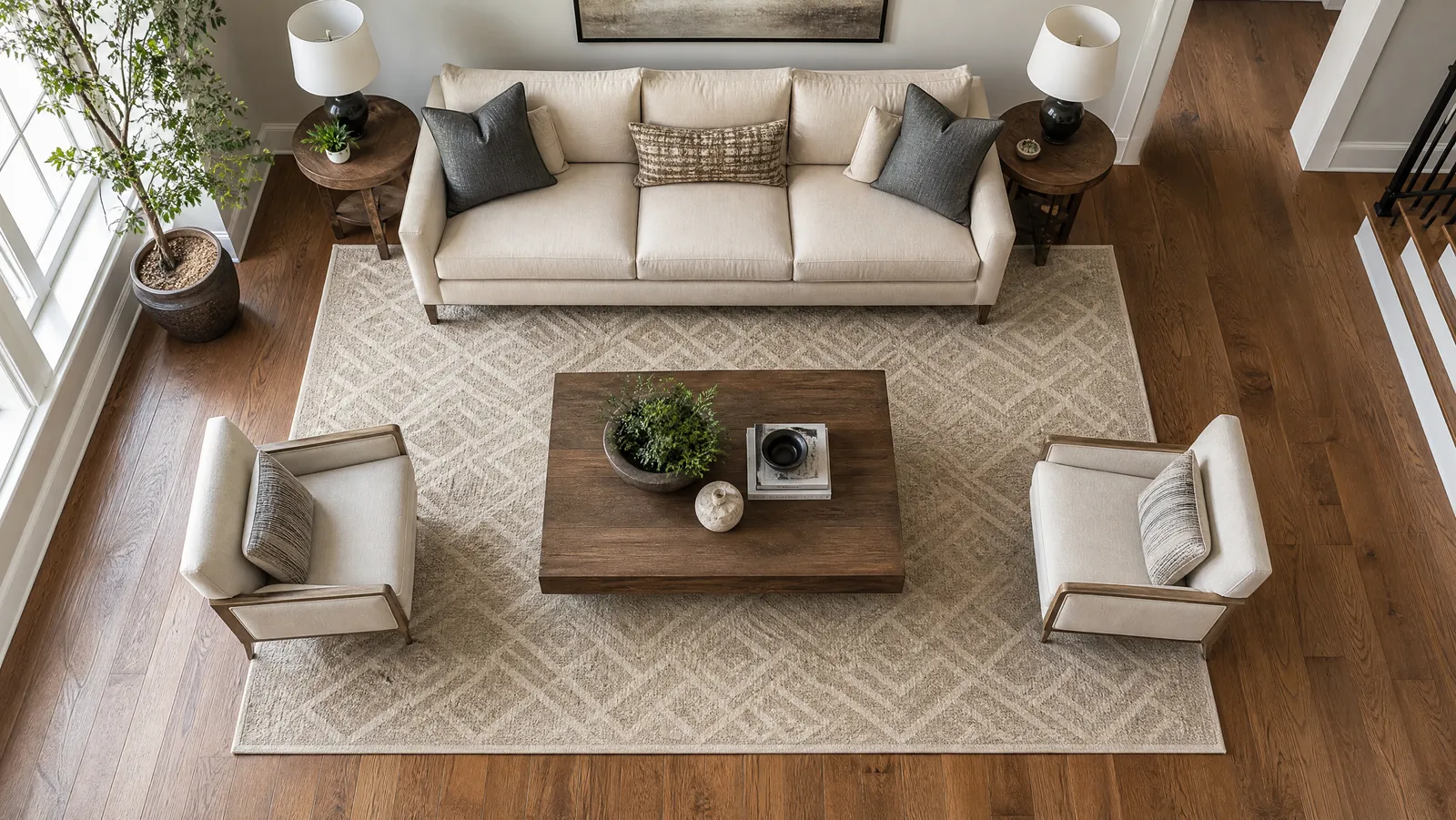
Most rooms want a bigger rug than you think. For a standard living room, that usually means an 8x10 or a 9x12; a queen bed pairs well with an 8x10, a king with a 9x12; and a six-seat dining table needs an 8x10 so the chairs stay on the rug. Below we walk through how to land on the exact size for your space.
Getting the size right is the single biggest decision in choosing the right area rug. Color, texture, and pattern all matter, but a rug that is a foot too small will read as a mistake no matter how beautiful the weave is. The good news: rug sizing runs on a handful of simple, repeatable rules, and once you know them you can size any room in about five minutes.
How to Measure Your Space Before You Buy
Start with the room, not the rug. Measure the full length and width of the floor, then measure the footprint of the furniture that will sit on or around the rug, such as the sofa and chairs in a living room or the table in a dining room. The rug needs to relate to the furniture grouping, not just the four walls.
Leave a border of bare floor around the rug so it does not run wall to wall like carpet. According to Super Area Rugs, a good general guideline is to keep roughly 12 to 18 inches of exposed floor between the edge of the rug and the walls, which frames the rug and makes the room feel intentional.
The most reliable way to avoid a sizing regret is to preview the rug before you order it. According to Well Woven, a designer trick is to tape the exact rug dimensions on the floor with painter's tape so you can see the scale, walk around it, and check clearances for doors and chairs before you commit.
To skip the arithmetic, plug your room and furniture measurements into the calculator below.
Even gap of exposed floor on every side. Retailers put the usable range at 8–24 in; 18 in is the common rule of thumb. Drop toward 8 in in small rooms.
Room geometry only — check the answer against your furniture before you buy.
ideal = (roomShort − 2·gap⁄12) × (roomLong − 2·gap⁄12), then snap DOWN to a standard size = (12 − 3) × (15 − 3) = 9.0 × 12.0 ft → 9 × 12 ftStandard sizes: 3×5, 4×6, 5×7, 5×8, 6×9, 7×10, 8×10, 9×12, 10×14, 12×15 ft. We snap DOWN to the largest that still leaves your chosen border on every side, and flag the next size up when it also stays inside the 8–24 in band — if the two are close, size up. In a living room, also make sure the rug reaches under the front legs of every seat.
This calculator sizes a rug to the ROOM only. It subtracts your chosen border of bare floor twice from each dimension — once per wall — then snaps DOWN to the largest standard rectangular size that still fits inside that footprint. The 18-inch default and the 8-to-24-inch range are retailer guidance, not physics: Rugs.com advises leaving “8 to 24 inches of bare floor between the edge of the rug and the wall”; Home Depot’s rule of thumb is 18 to 24 inches for a furniture-anchored layout and 12 to 18 when the furniture floats; Ruggable suggests 12 to 18. Designers disagree inside that band, so treat the slider as a taste control, not a formula.
What it assumes
- Room geometry only — it takes no furniture input. Home Depot’s own guide warns that “one of the most common reasons that rugs are returned is improper size selection” and that the “appropriate rug size should be determined based on furniture configuration and not on room size alone.”
- It snaps DOWN, so the answer is the largest rug that respects your border, not necessarily the right rug. Both of our rug guides say to size up when you are between two sizes, so the tool also surfaces the next size up whenever that size still leaves at least 8 in of bare floor.
- Only standard US rectangles are on the list: 3×5, 4×6, 5×7, 5×8, 6×9, 7×10, 8×10, 9×12, 10×14 and 12×15 ft. Square, round and runner rugs are not modelled, and 2×3 is excluded because retailers catalogue it as an accent mat, not an area rug.
- In a square or long narrow room a rectangle leaves very uneven borders. Check both border figures: when they differ a lot the tool says so, and a square rug, a round rug, a runner or two rugs is usually the better answer.
- Check the answer against your furniture: the rug should be at least as wide as your sofa with the front legs of every seat on it; a dining rug needs 24 in of clearance beyond the table on every side; a bedroom rug should extend at least 24 in past the bed.
- Tape the dimensions on the floor before you order. Every size here is a nominal size — hand-woven rugs run a couple of inches either way.
Sources
- What Size Rug Do I Need? The Complete Rug Size Guide for Every Room — Rugs.com (standard sizes 3×5 through 12×15; leave 8 to 24 inches of bare floor between rug and wall; front-legs-on rule)
- Selecting Proper Rug Size (PDF) — The Home Depot (18 to 24 inches between wall and rug, equal on all four sides if possible; furniture configuration over room size; bedroom at least 24 inches past the bed)
- Rug Size Guide — Ruggable (sizes include 2×3, 3×5, 4×6, 5×7, 6×9, 8×10, 9×12, 10×14; a 12 to 18 inch border of flooring for an 8×10)
- Rug Size & Placement Guide — Well Woven (leave 18 to 24 inches of exposed floor around the perimeter; stocks 5×7 and 7×10)
- Rug Size Guide — Living Spaces (at least four inches of exposed floor; 2×3 and 2×4 are “small rugs”; dining adds 24 to 30 inches per side)
Formula and constants last reviewed October 2026
Your result is a 9 × 12 ft rug — the big-room end of the lineup. The largest size we have reviewed hands-on is 8 × 10, so these are the closest matches we can stand behind; if your answer is a 9 × 12 or larger, check the seller's size dropdown for the same model before you settle for the 8 × 10.
An 8 × 10 is one tier under your 9 × 12, which means a wider band of bare floor in a 12 × 15 ft room — fine as long as the front legs of every seat still land on it. Low pile and washable is the right trade for the traffic a rug this size takes.
Check price on Amazon→Read the hardwood-floor rug reviewSame 8 × 10 footprint, patterned rather than plain. In a room sized for a 9 × 12 the rug reads as a floor, not an accent, so a medallion hides the traffic lane that a solid field will show.
Check price on Amazon→Read the living-room rug roundupThe natural-fibre look at 8 × 10 without the shedding — worth it when a rug this big sits under a dining table or an open-plan walkway, where a real jute would trap crumbs.
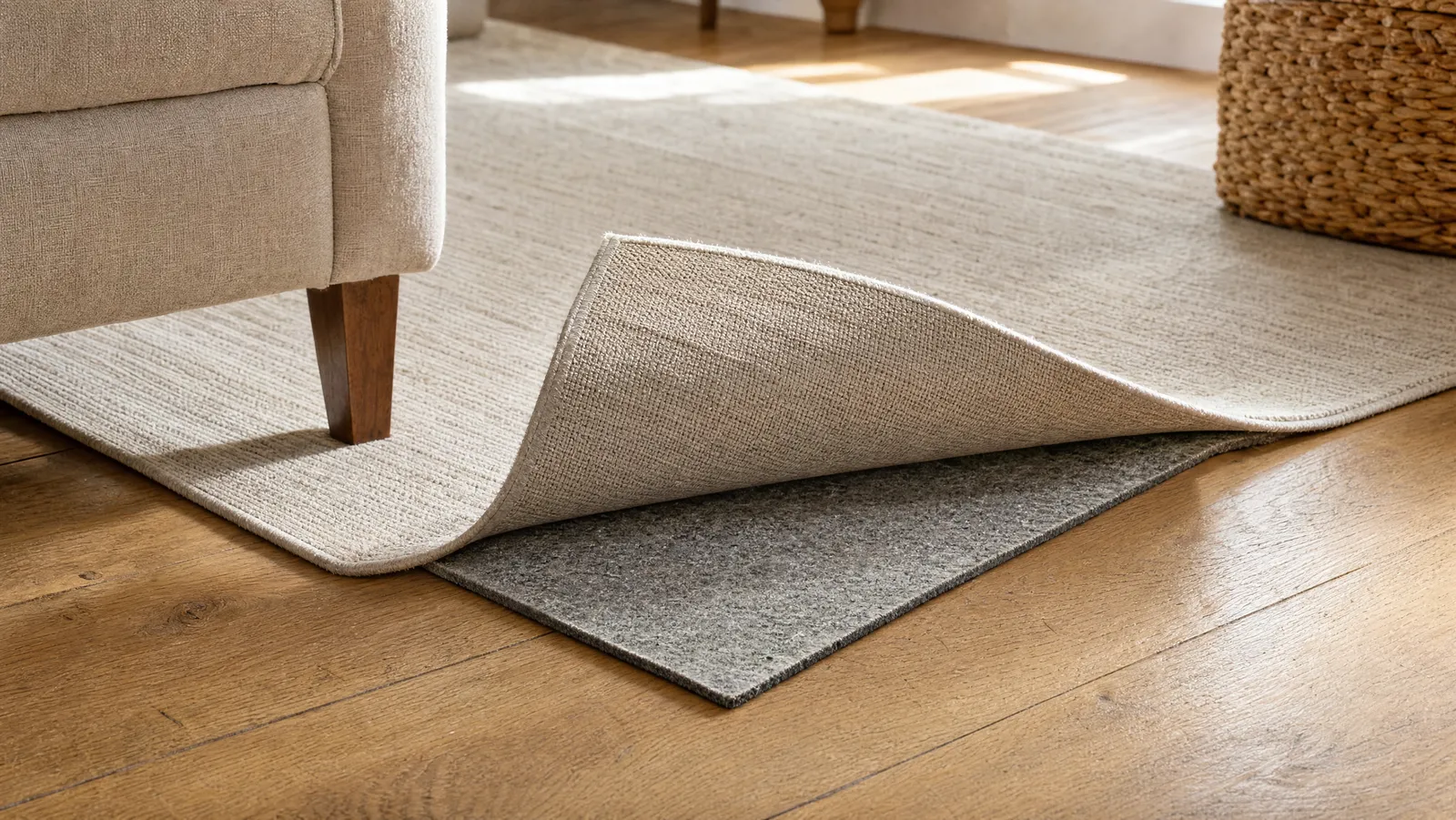
Check price on Amazon→Read the living-room rug roundupA pad should stop about an inch inside each rug edge, so for a 9 × 12 ft rug you cut this one down — Mohawk sells the 8 × 10 as trimmable, and a utility knife does it in a minute. Felt plus rubber is the combination that protects a hard floor.
Check price on Amazon→Read the rug-pad guide- The complete area rug size guide — every standard size room by room, and what to do when you are between two of them
- Do you need a rug pad? — felt, rubber and felt-plus-rubber, and how far inside the rug edge a pad should stop
- How to place an area rug — the front-legs-on rule, dining clearances and bedroom overhang — the furniture check this tool cannot do
Every rug pad we have reviewed is an 8 × 10 — Mohawk and RUGPADUSA both state theirs can be cut to size, and the alternates in our guide (RUGPADUSA Dual Surface, Gorilla Grip felt + rubber) are trimmable too. Cut it an inch smaller than the rug on every side. Sizes shown are the sizes we tested; sellers list other sizes of the same models, so check the size dropdown before you order.
As an Amazon Associate we earn from qualifying purchases. Picks come from our own published reviews; we never list a product we have not written about.
You can also reach this tool anytime, alongside our paint and lighting calculators, on the page for our free rug size calculator.
The Three Furniture Rules: All Legs On, Front Legs On, All Legs Off
Every rug-under-furniture layout falls into one of three approaches. Knowing which one you are aiming for tells you how big the rug has to be.
- All legs on. Every leg of every seating piece sits fully on the rug, with the rug extending several inches past the furniture. This is the most luxurious, cohesive look and it needs the largest rug. Reserve it for spacious rooms and open-plan spaces.
- Front legs on. Only the front legs of the sofa and chairs rest on the rug while the back legs sit on bare floor. This is the workhorse layout for most living rooms because it still anchors the seating group but uses a more affordable, more common size. According to Lulu and Georgia, a living room rug should at minimum be large enough that the front legs of the sofa and chairs rest on it.
- All legs off. The rug floats entirely within the seating area with no furniture touching it, usually under a coffee table. This works only for small rooms, reading nooks, or as a layered accent, and it is the easiest layout to get wrong.
When in doubt, aim for front legs on or all legs on. A rug that touches your furniture always looks more deliberate than one stranded in the middle of the floor.
Standard Area Rug Sizes and What Each One Suits
Rugs are sold in a set of predictable dimensions, which makes shopping easier once you know the lineup. According to Super Area Rugs, the most common standard rug sizes are 3x5, 4x6, 5x8, 6x9, 8x10, 9x12, and 10x14 feet, and these account for the vast majority of rugs sold because they fit the furniture arrangements found in most homes.
Here is what each size tends to suit:
- 2 by 3 feet and 3x5: Accent sizes for entryways, kitchen sinks, and bedsides.
- 4x6 and 5x8: Small-room rugs and layering pieces; a 5x8 also works as a front-legs-on rug for a compact living room or under a twin bed.
- 6x9: A good in-between for medium living rooms and smaller seating groups.
- 8x10: The most versatile size in the catalog. According to Super Area Rugs, the 8x10 is the single most popular size because it handles a medium living room in a front-legs-on layout, works under a queen bed, and suits a six-seat dining table.
- 9x12 and 10x14: Large-room rugs for open floor plans, sectionals, king beds, and larger dining tables.
Do not forget runners. According to Super Area Rugs, runners are made for hallways, kitchen galleys, and the sides of a bed, with the most common widths landing around 2.5 and 3 feet so a few inches of floor stay visible on each side.
The Best Area Rug Size for a Living Room
For most living rooms, the choice comes down to an 8x10 or a 9x12. Both are large enough to connect the sofa, coffee table, and accent chairs into one grouping rather than leaving them stranded on separate patches of floor.
Use the front-legs-on rule to pick between them. Set your rug so the front legs of the sofa and any chairs land on it, with the coffee table fully centered on top. In a room roughly 12 feet wide, an 8x10 usually delivers that. Once the room stretches to about 13 feet or wider, or you are working with a large sectional, step up to a 9x12 so the seating still reaches the rug and the proportions stay generous.
If your seating floats in the middle of the room rather than against a wall, aim higher and consider an all-legs-on layout, which may push you toward a 9x12 or larger so every piece sits comfortably on the rug.
Choosing a Rug Size for the Bedroom
In the bedroom, the rug's job is to give you a soft landing when you step out of bed, so size it around the bed rather than the seating. The most common approach is to run one large rug under the lower two-thirds of the bed, starting just in front of the nightstands, so warm rug greets your feet on both sides and at the foot.
According to Rug & Carpet, a bedroom rug should extend at least 18 to 24 inches beyond the sides and the foot of the bed to create that practical landing area, and the go-to pairings are an 8x10 under a queen bed and a 9x12 under a king. For a twin bed, a 5x8 at the foot or a pair of small runners flanking the mattress both work well.
Two quick cautions for bedrooms: make sure the rug does not block the swing of a door or closet, and if you are torn between two sizes, size up. A rug that vanishes almost entirely under the bed frame tends to look like an afterthought.
Dining Room Rug Size: The 24-Inch Rule
Dining rooms have the strictest sizing rule of any room, and it exists to protect a very specific moment: pushing your chair back to sit down or stand up. If the rug is too small, the back chair legs catch on its edge and the rug bunches or tips the chair.
The fix is simple. According to Rugs Direct, a dining room rug should extend at least 24 inches beyond the table on every side so the chairs stay fully on the rug even when pulled out. That number is not arbitrary; a standard dining chair is about 18 to 20 inches deep, and the back of the chair travels roughly 22 to 24 inches from the table edge as you slide it out.
In practice that means measuring your table, adding at least 24 inches (48 inches total) to both the length and the width, and then choosing the next rug size up. A typical six-seat rectangular table lands on an 8x10, while an eight-seat table usually needs a 9x12. Round and oval tables follow the same math; just picture the widest point of the table when you add your clearance.
8x10 vs 9x12: A Quick Decision Note
These two sizes cover most rooms, so here is the fast way to choose:
- Reach for the 8x10 when your living room is around 12 feet wide, your bed is a queen, or your dining table seats six. It is the most versatile size and the easiest to place in a front-legs-on layout.
- Step up to the 9x12 when your room is about 13 feet or wider, you have a sectional or a king bed, your dining table seats eight, or you want every furniture leg on the rug.
The extra foot in each direction on a 9x12 adds meaningful coverage, so if your measurements sit right on the line between the two, the larger rug is almost always the safer call.
Common Rug Sizing Mistakes to Avoid
A few errors show up again and again, and nearly all of them point in the same direction.
- Buying too small. According to Van Vreede's, the most common mistake people make is choosing a rug that is too small, which leaves the furniture disconnected and makes the whole room feel fragmented. When you are between sizes, size up.
- Floating the rug. A small rug marooned under only the coffee table cheapens the look and can make the room feel smaller. Keep at least the front legs of your seating on the rug.
- Matching one dimension but not the other. A rug that fits the width but falls short on length feels awkward. Check both directions against your furniture footprint.
- Ignoring clearances. Forgetting door swing, drawer pulls, and dining-chair movement is an easy way to end up with a rug that technically fits but never works day to day.
Size interacts with durability, too. In a busy household with kids or pets, a rug big enough to anchor the room also takes more foot traffic, more spills, and more claws, so pairing the right size with a hard-wearing, cleanable weave matters. If that describes your home, see our guide to the best area rugs for pets for materials that hold up. Two related decisions we cover elsewhere are rug placement and rug pads, both of which affect how a correctly sized rug actually feels underfoot.
Putting It All Together
Rug sizing really does come down to a short checklist: measure the room and the furniture, leave a border of bare floor, decide whether you want all legs on, front legs on, or all legs off, and then round up rather than down. Follow the 24-inch rule in the dining room, extend the rug 18 to 24 inches past the bed, and lean on the 8x10 or 9x12 that fits almost every living room.
Get the dimensions right first, then move on to color, pile, and pattern. For the full walkthrough of everything after size, read our companion guide on how to choose an area rug, and tape out your dimensions on the floor before you order so the rug that arrives is the one your room actually needs.
The Author
About the author
Interior Designer
Donald Martin
Designer since 2006 and a lifelong lover of rescued objects, Donald Martin knows how to give a second life to pieces and weave them into an eclectic, personalized interior. He writes about decorating real homes on a real budget.