Rugs · 19 min read
How to Choose an Area Rug: The Complete Buyer's Guide
 Donald Martin
To choose an area rug, start with size: buy the largest rug that fits the room while leaving an even border of bare floor around it. Then pick a material suited to the room's traffic, and place it so it anchors your furniture rather than floating in the middle. Get those three decisions right and the styling takes care of itself.
That is the whole job in one paragraph, but each of those decisions has a few rules worth knowing before you spend real money. Learning how to choose an area rug is mostly about sequencing: people fall in love with a pattern first, buy whatever size is on sale, and end up with a rug that looks marooned. We do it in the opposite order. This guide walks the decisions in the order that actually matters, from sizing and material through placement, cleaning, rug pads, and the finer points designers use, so you can buy once and be happy for years.
How to Size an Area Rug for Any Room
Size is the decision that makes or breaks a room, and it is the one most people get wrong. The instinct is to buy small to save money; the result is a rug that looks like a bath mat stranded in the middle of the floor. The fix is a simple frame rule.
According to Houzz's area rug guide, the classic starting point is to leave about 18 inches of bare floor between the edge of the rug and the walls, which reads as a deliberate frame around the room. That number flexes with the space: Houzz notes you can drop to about 8 inches in smaller rooms, and adds that this frame rule suits enclosed rooms better than large, open-plan spaces. So the practical band is 8 to 18 inches of exposed floor on every side — enough to feel intentional, not so much that the rug looks undersized.
The second rule is about furniture legs. In a living room you have three honest options:
- All legs on: every leg of the sofa and chairs sits on the rug. The most luxurious look, and it needs the biggest rug (often 9x12 or larger).
- Front legs on: only the front legs of each seat rest on the rug. This is the workhorse choice for most rooms and usually calls for an 8x10.
- All legs off: the rug floats in front of the seating as an accent. This only works with a coffee-table-and-rug grouping and a genuinely small room.
Common sizes map to common rooms: a 5x7 or 6x9 suits a bedroom accent or small sitting area, an 8x10 anchors most living rooms, and a 9x12 covers larger open floor plans. When you are between two sizes, size up. A rug that is slightly too big reads as generous; one that is too small reads as a mistake. For the room-by-room breakdown, see our complete area rug size guide.
The fastest way to skip the arithmetic is to enter your room's dimensions and let the tool find the nearest standard rug. You can also open our free rug size calculator for the same math alongside our paint and lighting tools.
Even gap of exposed floor on every side. Retailers put the usable range at 8–24 in; 18 in is the common rule of thumb. Drop toward 8 in in small rooms.
Room geometry only — check the answer against your furniture before you buy.
ideal = (roomShort − 2·gap⁄12) × (roomLong − 2·gap⁄12), then snap DOWN to a standard size = (12 − 3) × (15 − 3) = 9.0 × 12.0 ft → 9 × 12 ftStandard sizes: 3×5, 4×6, 5×7, 5×8, 6×9, 7×10, 8×10, 9×12, 10×14, 12×15 ft. We snap DOWN to the largest that still leaves your chosen border on every side, and flag the next size up when it also stays inside the 8–24 in band — if the two are close, size up. In a living room, also make sure the rug reaches under the front legs of every seat.
This calculator sizes a rug to the ROOM only. It subtracts your chosen border of bare floor twice from each dimension — once per wall — then snaps DOWN to the largest standard rectangular size that still fits inside that footprint. The 18-inch default and the 8-to-24-inch range are retailer guidance, not physics: Rugs.com advises leaving “8 to 24 inches of bare floor between the edge of the rug and the wall”; Home Depot’s rule of thumb is 18 to 24 inches for a furniture-anchored layout and 12 to 18 when the furniture floats; Ruggable suggests 12 to 18. Designers disagree inside that band, so treat the slider as a taste control, not a formula.
What it assumes
- Room geometry only — it takes no furniture input. Home Depot’s own guide warns that “one of the most common reasons that rugs are returned is improper size selection” and that the “appropriate rug size should be determined based on furniture configuration and not on room size alone.”
- It snaps DOWN, so the answer is the largest rug that respects your border, not necessarily the right rug. Both of our rug guides say to size up when you are between two sizes, so the tool also surfaces the next size up whenever that size still leaves at least 8 in of bare floor.
- Only standard US rectangles are on the list: 3×5, 4×6, 5×7, 5×8, 6×9, 7×10, 8×10, 9×12, 10×14 and 12×15 ft. Square, round and runner rugs are not modelled, and 2×3 is excluded because retailers catalogue it as an accent mat, not an area rug.
- In a square or long narrow room a rectangle leaves very uneven borders. Check both border figures: when they differ a lot the tool says so, and a square rug, a round rug, a runner or two rugs is usually the better answer.
- Check the answer against your furniture: the rug should be at least as wide as your sofa with the front legs of every seat on it; a dining rug needs 24 in of clearance beyond the table on every side; a bedroom rug should extend at least 24 in past the bed.
- Tape the dimensions on the floor before you order. Every size here is a nominal size — hand-woven rugs run a couple of inches either way.
Sources
- What Size Rug Do I Need? The Complete Rug Size Guide for Every Room — Rugs.com (standard sizes 3×5 through 12×15; leave 8 to 24 inches of bare floor between rug and wall; front-legs-on rule)
- Selecting Proper Rug Size (PDF) — The Home Depot (18 to 24 inches between wall and rug, equal on all four sides if possible; furniture configuration over room size; bedroom at least 24 inches past the bed)
- Rug Size Guide — Ruggable (sizes include 2×3, 3×5, 4×6, 5×7, 6×9, 8×10, 9×12, 10×14; a 12 to 18 inch border of flooring for an 8×10)
- Rug Size & Placement Guide — Well Woven (leave 18 to 24 inches of exposed floor around the perimeter; stocks 5×7 and 7×10)
- Rug Size Guide — Living Spaces (at least four inches of exposed floor; 2×3 and 2×4 are “small rugs”; dining adds 24 to 30 inches per side)
Formula and constants last reviewed October 2026
Your result is a 9 × 12 ft rug — the big-room end of the lineup. The largest size we have reviewed hands-on is 8 × 10, so these are the closest matches we can stand behind; if your answer is a 9 × 12 or larger, check the seller's size dropdown for the same model before you settle for the 8 × 10.
An 8 × 10 is one tier under your 9 × 12, which means a wider band of bare floor in a 12 × 15 ft room — fine as long as the front legs of every seat still land on it. Low pile and washable is the right trade for the traffic a rug this size takes.
Check price on Amazon→Read the hardwood-floor rug reviewSame 8 × 10 footprint, patterned rather than plain. In a room sized for a 9 × 12 the rug reads as a floor, not an accent, so a medallion hides the traffic lane that a solid field will show.
Check price on Amazon→Read the living-room rug roundupThe natural-fibre look at 8 × 10 without the shedding — worth it when a rug this big sits under a dining table or an open-plan walkway, where a real jute would trap crumbs.
Check price on Amazon→Read the living-room rug roundupA pad should stop about an inch inside each rug edge, so for a 9 × 12 ft rug you cut this one down — Mohawk sells the 8 × 10 as trimmable, and a utility knife does it in a minute. Felt plus rubber is the combination that protects a hard floor.
Check price on Amazon→Read the rug-pad guide- The complete area rug size guide — every standard size room by room, and what to do when you are between two of them
- Do you need a rug pad? — felt, rubber and felt-plus-rubber, and how far inside the rug edge a pad should stop
- How to place an area rug — the front-legs-on rule, dining clearances and bedroom overhang — the furniture check this tool cannot do
Every rug pad we have reviewed is an 8 × 10 — Mohawk and RUGPADUSA both state theirs can be cut to size, and the alternates in our guide (RUGPADUSA Dual Surface, Gorilla Grip felt + rubber) are trimmable too. Cut it an inch smaller than the rug on every side. Sizes shown are the sizes we tested; sellers list other sizes of the same models, so check the size dropdown before you order.
As an Amazon Associate we earn from qualifying purchases. Picks come from our own published reviews; we never list a product we have not written about.
Keeping Your Area Rug Clean
A rug is a horizontal filter for your whole home — it catches grit, dust, pet hair, and whatever the bottoms of shoes carry in. Left in the pile, that grit acts like sandpaper on the fibers every time someone walks across, which is why a neglected rug wears out from the inside long before it looks dirty. The single most valuable habit for making a rug last is unglamorous: vacuum it.
According to Ayoub Carpet Service, area rugs should be vacuumed once or twice a week, stepping up to two or three times a week in high-traffic zones like hallways and living rooms, and daily in homes with shedding pets. Use a suction-only setting or turn off the beater bar for delicate or looped weaves, and stop running the vacuum over fringe, which snags and tears.
For spills, speed beats technique. Blot — never rub — with a clean white cloth, working from the outside of the spot inward so you do not spread it. Rubbing pushes the stain deeper into the pile and can distort the weave. Plain water handles most fresh spills; for stubborn spots, a little mild dish soap in cool water is safer than harsh cleaners that can strip dye. Always test any cleaner on a hidden corner first.
Even with perfect daily habits, rugs need a periodic deep clean to pull out the fine soil that vacuuming leaves behind. According to a rug-washing specialist, the general baseline is a professional deep clean every 12 to 18 months, and more often for homes with allergies, pets, or heavy foot traffic. Between professional visits you can freshen most synthetic rugs at home. If you want the full walk-through of blotting, drying, and stain-specific tactics, our companion piece on how to clean an area rug covers each fiber type in detail. The short version: vacuum often, blot fast, and deep clean on a schedule, and a good rug will outlast the room around it.
Washable Rugs: The Modern Option
Machine-washable rugs are the biggest change in the rug market of the last decade, and for a lot of households they solve the exact problem that keeps a nice rug out of a busy room. The idea is simple: a thin, low-profile rug you can lift, fold, and run through a home washer instead of hauling to a cleaner.
According to Revival Rugs, most washable rugs are woven from recycled polyester, often in a flat chenille construction, and are deliberately kept low-profile so they fit inside a standard residential washing machine. That flat weave is the trade-off and the feature at once: you lose the deep plush of a thick wool pile, but you gain a rug you can actually clean yourself when a toddler upends a juice cup.
They do have rules. According to Tumble, washable rugs should be laundered on a cold, gentle cycle with a mild detergent and low or no heat, because hot water and high-heat drying are what break down the fibers and backing over time. Frequent washing can gradually wear any rug, so treat the washer as your deep-clean tool a couple of times a year, not a weekly habit. Many washable designs also come in two pieces — a thin top rug plus a separate grippy pad — so check whether the pad is included or sold separately.
Who are they for? If you have young kids, pets, a mudroom, a kitchen, or a rental where a permanent expensive rug feels risky, a washable rug is an easy yes. If you want a heirloom-grade centerpiece for a formal living room that rarely takes a spill, it is not the category for you. We break down the full case for and against — durability, feel, and cost over five years — in our guide to whether washable area rugs are worth it. For most real, lived-in homes, the honest answer is that they earn their place.
Choosing the Right Rug Material
Material determines almost everything you will feel and pay for over a rug's life: how soft it is underfoot, how well it hides dirt, how long it lasts, and how much a spill will cost you in stress. Four families cover nearly every rug worth buying.
Wool is the benchmark. It is naturally soft, resilient, and flame-resistant, it hides soil well, and it takes dye beautifully. According to RugKnots, a well-made wool rug can last 50 years or more because wool fibers are crimped and elastic, so they spring back instead of crushing under furniture. The trade-offs are price and a tendency to shed loose fibers for the first several months. Wool is the choice when you want one rug to last decades.
Natural fibers like jute, sisal, and seagrass bring texture and an organic, neutral look at a lower price. They are wonderfully durable in dry, low-spill areas but not friends with moisture — they stain readily and can warp if they get wet, so keep them out of kitchens, bathrooms, and damp basements.
Cotton is soft, affordable, and often machine-washable in smaller sizes, which makes it great for kitchens, kids' rooms, and casual spaces. It is less durable than wool and can look worn faster in heavy traffic, so think of it as a refreshable rug rather than a forever one.
Synthetics — mainly polypropylene (olefin) and polyester — are the value and stain-resistance champions. According to RugKnots, polypropylene resists water-based stains because it does not absorb liquid, but it typically shows crushing and wear in a high-traffic spot within 3 to 5 years, and it can hold onto oil-based stains permanently. That makes synthetics ideal for playrooms, patios, and busy family rooms where you expect to replace the rug eventually. For a side-by-side on feel, cost, and care by fiber, see our rug materials comparison. As a rule: wool to keep for decades, natural fiber for texture, cotton for washable casual, synthetic for spills and budgets.
Why You Need a Rug Pad
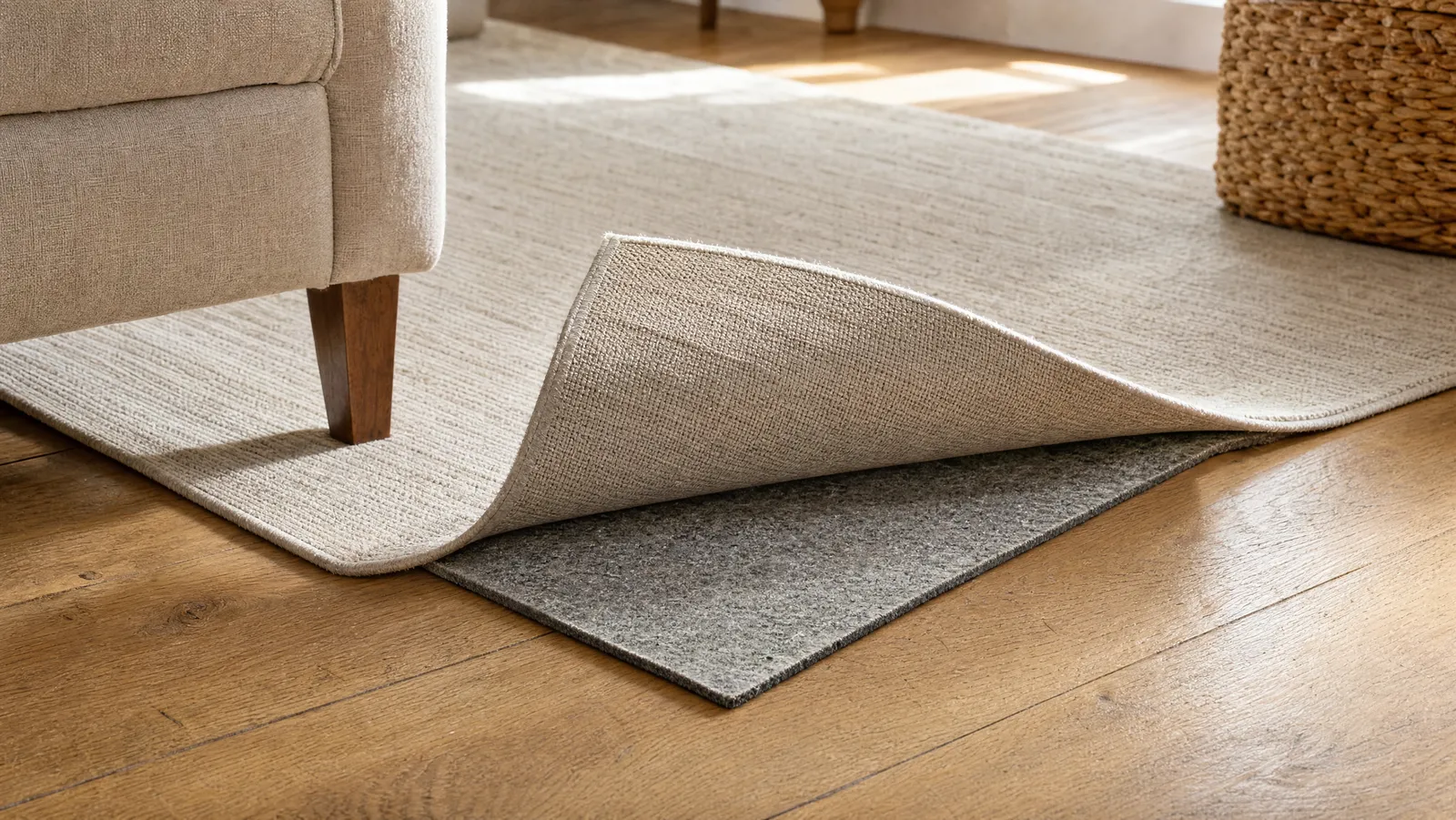
A rug pad is the cheapest upgrade in the entire process and the one people skip most often. It is a thin cushioning underlayment that sits between the rug and the floor, and it quietly does four jobs at once. Skip it and you will feel the difference, and eventually pay for it.
First, safety. A pad grips both the floor and the rug so the rug stops sliding, bunching, and curling at the corners — the classic trip hazard, especially on hard floors and with lightweight washable rugs.
Second, longevity. According to RugPadUSA, a pad absorbs much of the impact of foot traffic, cushioning the fibers so they crush and wear more slowly, which measurably extends the life of the rug above it. In effect, the pad takes the beating so the rug does not.
Third, floor protection. According to Ralph's Hardwood Flooring, a rug pad acts as a buffer that keeps grit and the rug's own backing from grinding against and scratching the floor underneath, and many pads add a moisture barrier so spills do not soak straight into wood. This matters most on hardwood, where a rubber-backed rug with no pad can discolor or mar the finish.
Fourth, comfort and quiet. A pad adds a layer of softness underfoot and dampens footsteps and echo, so the room feels both plusher and calmer. It also lets a little air circulate under the rug, which helps prevent trapped moisture and odors.
A few buying notes: choose a pad about one inch smaller than your rug on all sides so it disappears under the edges, and match the pad to your floor. Felt-and-natural-rubber pads are the safe, grippy standard for hardwood; avoid cheap solid PVC or adhesive pads on wood, since they can react with the finish over time. If you are weighing the cost against the benefit, our deeper look at whether you need a rug pad settles it: for a few dollars, you protect the two most expensive things in the equation — your floor and your rug.
Rug Placement Rules by Room
Placement is where sizing turns into a finished look, and each room has its own logic. Get the rug positioned correctly and even a modest rug makes the furniture feel like it belongs together.
Living room. Center the rug on the primary seating group, not on the room's geometry, and pull the front legs of every seat onto it (or all the legs, if the rug is large enough). The rug should be wide enough that it visually connects the sofa and chairs — if it only reaches the coffee table, it is too small. Leave that even 8-to-18-inch border of floor around the arrangement.
Bedroom. The rug should read as a soft frame around the bed. As a common designer guideline, a rug should extend about 18 inches beyond the sides of a king or queen bed, and about 12 inches for a full or twin, so your feet land on softness when you get up. You can run one large rug fully under the bed and nightstands, or use a runner on each side for a lighter, budget-friendly version.
Dining room. The controlling rule is chair movement. According to Houzz, the rug should extend at least 24 inches beyond the table edge on every side so the back chair legs stay on the rug even when someone pushes back to stand. Measure your table with the leaves in and add four feet to each dimension as a quick starting point. Flatweave or low-pile rugs are far easier to slide chairs across and to clean under a dining table.
Entryways and hallways. Runners should leave a few inches of floor on each side rather than reaching wall to wall, and here durability and washability matter more than plushness.
The through-line for every room is the same: anchor the furniture, keep the border even, and let the rug define the zone. Our full walkthrough on how to place an area rug adds layouts and diagrams for tricky, open-plan, and multi-rug spaces.
Layering Rugs Like a Designer
Layering — setting a smaller, more decorative rug on top of a larger, plainer one — is the trick that makes a room look styled rather than furnished. It adds warmth, texture, and a sense of collected-over-time depth, and it is also a practical way to make an interesting-but-small rug work in a big room, or to add softness over a hard natural-fiber base.
The reliable formula has three parts. Start with a large, flat, neutral base — a jute, sisal, or low-pile wool rug sized as if it were the only rug in the room, following the same border rules from the sizing section. This layer does the heavy lifting of anchoring the furniture.
Then add a smaller top rug with the personality: a bold pattern, a vintage kilim, a shag, or a rich color. It should be noticeably smaller than the base so a frame of the base rug shows all the way around, which is what makes the layering read as intentional.
The magic is in contrast. Pair different textures rather than similar ones — a smooth flatweave over a chunky jute, or a plush pile over a tight natural fiber — and vary the scale of any patterns so they do not fight. Keep the two rugs in the same broad color family so the result feels layered, not cluttered. Anchor everything with a rug pad underneath so nothing shifts.
Layering also solves real problems: it hides a worn or boring base rug, adds insulation and quiet over hard floors, and lets you refresh a room seasonally by swapping only the top rug. If you want the full playbook with pairings that work, we cover how to layer rugs step by step. Used with restraint, it is the single fastest way to make a room look like a designer touched it.
Best Rugs for Pets and High-Traffic Homes
A rug in a house with pets, kids, or a steady stream of foot traffic has to survive claws, accidents, muddy paws, and constant wear. The good news is that the market has caught up, and you no longer have to choose between a rug that looks good and one that can take a beating.
Three properties matter most for busy homes. Stain resistance comes first: synthetic fibers like polypropylene and polyester shrug off water-based accidents because they do not absorb liquid, which is why they dominate the pet-friendly category. Washability is the next tier up — a machine-washable rug means a pet accident is a laundry problem, not a professional-cleaning bill. And construction matters: choose a low pile or flatweave, which gives claws less to snag and traps far less hair and dander than a deep shag.
Color and pattern do quiet work too. A mid-tone, multicolor, or subtly patterned rug hides between-cleaning dirt and the occasional stray hair vastly better than a solid cream or charcoal, which show everything. For the fiber itself, skip loop weaves like Berber in homes with cats, since a single pulled loop can run across the rug, and favor cut-pile or flatweave instead.
Durability under traffic tracks with the fiber's resilience. Wool is naturally springy and hides soil, but the standout value play for a busy home is a washable synthetic that combines stain resistance with the ability to actually launder the whole rug. It is worth noting that a synthetic in a high-traffic lane will show wear in a handful of years, so treat it as a rug you will happily replace rather than an heirloom. Our dedicated roundup of the best area rugs for pets names specific models by durability and washability. Match the rug to the chaos and you get a floor that looks good and cleans up in minutes.
Rugs for Hardwood Floors
Hardwood and rugs are a classic pairing, but the wrong rug setup can scratch, dent, or discolor the exact floor you are trying to show off. A few precautions keep both looking their best.
The first and most important is the pad, and here the type is critical. According to Ralph's Hardwood Flooring, a rug pad buffers the floor from grit and abrasion and keeps the rug's backing from grinding against the finish. On wood, choose a felt-and-natural-rubber pad and specifically avoid cheap solid-PVC or adhesive-backed pads, which can react with a wood finish over time and leave a haze or sticky residue that is miserable to remove.
Second, mind the backing of the rug itself. A rubber or latex non-slip backing pressed directly against hardwood can trap moisture and, in some cases, discolor the finish, especially in sunlight. That is exactly why a separate pad is the safer solution than a rug that relies on its own grippy underside.
Third, protect against sun and moisture. Wood under a rug ages differently than the exposed floor around it, so a rug left in one spot for years can leave a lighter rectangle when you finally move it. Rotate the rug a couple of times a year so the floor beneath weathers evenly, and clean up spills quickly so nothing seeps through to the wood.
As for the rug itself, low-pile wool and flatweaves are gentle, timeless choices over hardwood, while a well-backed washable rug works well in high-traffic entries and kitchens. Our specific picks for the best area rugs for hardwood floors weigh backing, pile, and pad compatibility together. Do the pad right and rotate on a schedule, and a rug will protect your hardwood rather than harm it.
Budget-Friendly Washable Picks
You do not need to spend hundreds to get a rug that looks good and cleans easily. The washable category in particular has pushed prices down, and at smaller sizes there are genuinely good options for well under a hundred dollars — perfect for kitchens, entries, kids' rooms, and rentals.
Shopping smart at this price point comes down to a few checks. First, confirm it is fully machine-washable, not just spot-cleanable, and confirm the size that actually fits your washer — most home machines handle a 3x5 or smaller comfortably, while a 5x7 may need a large-capacity or laundromat machine. Second, check whether a pad or non-slip backing is included; a cheap rug plus a separate pad can still be a bargain, but budget for both so the rug does not slide. Third, read the fiber and pile: a flat, low-profile recycled-polyester or cotton weave washes and dries best, while anything thick or shaggy fights your washer.
A couple of habits stretch a budget rug further. Wash on cold with mild detergent and skip high heat, exactly as you would treat any washable rug, so the fibers and backing last through many cycles rather than a handful. And choose a forgiving mid-tone pattern that hides dirt between washes, which effectively lowers how often you need to launder it at all.
Do not expect a 40-dollar rug to feel like wool underfoot or last a decade — that is not the deal. The deal is a fresh, washable, decent-looking rug for the rooms where spills are a matter of when, not if, at a price that makes replacing it painless. Our curated list of the best washable area rugs under $100 points to the specific styles that punch above their price. Buy for the room's reality, keep a pad under it, and a budget rug earns its keep.
Conclusion
Choosing a rug well is not about taste first — it is about order. Size the rug to frame the room and anchor the furniture, pick a fiber that matches how the room is actually used, put a proper pad underneath, and set a simple cleaning rhythm. Do those four things and the pattern you fall in love with will look right for years, because it is sitting on a foundation of good decisions. Everything else in this guide — washability, layering, room-by-room placement, pet-proofing — is refinement on top of that core. Start with size, and let the rest follow.
Explore the full series
- Area Rug Sizes: The Complete Guide for Every Room — How to measure your space and choose the right rug size for every room.
- How to Clean an Area Rug at Home (Without Ruining It) — Routine care, spot cleaning, and deep-cleaning steps that won't ruin the fibers.
- Are Washable Area Rugs Worth It? An Honest Look — An honest look at where machine-washable rugs shine and where they fall short.
- Rug Materials Compared: Wool, Jute, Cotton and Synthetics — Wool, jute, cotton, and synthetics compared on feel, durability, and care.
- Do You Need a Rug Pad? Types, Benefits and How to Choose — What a pad actually does, the four pad types, and how to pick thickness and size.
- How to Place an Area Rug: Layout Rules for Every Room — Layout rules for living rooms, bedrooms, dining rooms, and open-plan spaces.
- How to Layer Rugs Like a Designer — The size gaps, pairings, and rules that make a layered floor look intentional.
- Best Area Rugs for Pets and High-Traffic Homes — Durable, washable, stain-resistant picks that survive claws, spills, and busy floors.
- Best Area Rugs for Hardwood Floors (That Won't Scratch) — Backing, pile, and pad choices that protect a wood finish instead of marring it.
- Best Washable Area Rugs Under $100 — Genuinely machine-washable picks under $100, with the trade-offs stated plainly.
The Author
About the author
Interior Designer
Donald Martin
Designer since 2006 and a lifelong lover of rescued objects, Donald Martin knows how to give a second life to pieces and weave them into an eclectic, personalized interior. He writes about decorating real homes on a real budget.