Rugs · 14 min read
How to Layer Rugs Like a Designer
 Donald Martin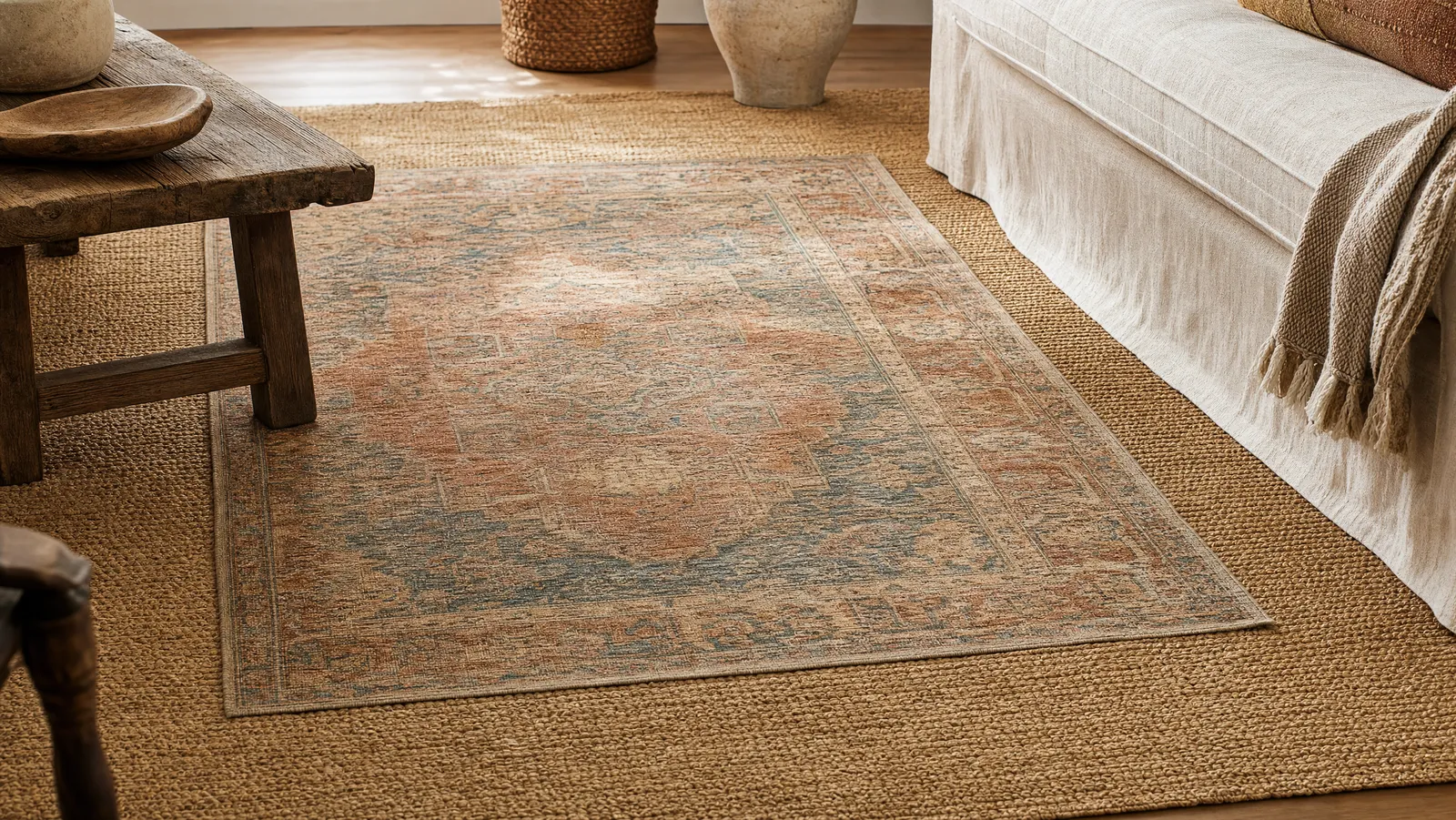
To layer rugs, start with a large, flat, neutral base — almost always jute or sisal — and set a smaller, higher-contrast rug on top of it, leaving a wide and even border of the base showing on all four sides. The size gap is the entire trick. Get it wrong and the two rugs read as a mistake; get it right and the floor looks composed.
That is how to layer rugs in a single paragraph. Everything below is the detail that separates a layered floor that looks designed from one that looks like you could not decide. If you are still working out what rug to buy in the first place, start with our area rug buyer's guide — layering is a technique you apply to the right rug, not a rescue for the wrong one.
Why Layering Rugs Is Worth the Trouble
There are four honest reasons to put one rug on top of another, and none of them is "it looks cool on Pinterest."
- It covers a big floor for less money. A 9x12 wool rug is a serious purchase. A 9x12 jute base plus a 5x8 vintage-style rug on top usually costs a fraction of that.
- It adds texture that one rug cannot. Rough natural fiber underneath, something soft and finely woven on top. According to Homes and Gardens, the comfort of a sheepskin over rustic jute is one of the pairings designers return to again and again.
- It rescues a rug that is the wrong size. If you own a beautiful 5x7 that is swimming in an 8x10 room, a jute base gives it the footprint it needs without you selling it.
- It hides a floor you cannot change. Rental carpet, a dated tile, a patched hardwood seam — two rugs cover more ground and look intentional doing it.
What layering does not do is fix a rug that clashes with the room. Two wrong rugs stacked are still two wrong rugs.
The Base Layer: Jute Rug Layering Starts From the Floor Up
The base has one job: be big, be flat, and be boring. Nearly every designer guide we read lands on the same short list of materials — jute, sisal, seagrass, or a woven-wool flatweave — because they are neutral, textural, and thin. According to Sisal Rugs Direct, the best bottom-layer rugs are durable natural fibers like jute and sisal, because they give you a natural, neutral palette to layer more colorful rugs on top of — the base reads as texture rather than pattern, so whatever you put on top stays the star. Studio McGee's approach is the same idea in its most recognizable form: a large natural-fiber rug underneath, a smaller vintage rug with real character on top.
Three things to check before you buy a base:
- Pile height under half an inch. Thin is not a style preference here, it is structural. A thick base under a thick top rug bulges, rocks underfoot, and catches toes. If you can only control one variable, control this one.
- A flat, unfussy weave. Chunky braided and boucle jute look great alone but they telegraph their texture through a thin top rug and make the whole stack feel lumpy. A tight, even weave sits quietly.
- Buy the base at full room size. The base should be the rug you would have bought if you were not layering at all — the one that anchors the furniture. In most living rooms that is an 8x10 or 9x12. If you are not sure which, measure your room and let the size calculator pick the base, then shop the top rug a size or two smaller.
One caveat on material: jute is softer underfoot but sheds more in its first weeks and holds water rings longer, while sisal is rougher, more abrasion-resistant, and the better pick for heavy traffic. We compared the trade-offs in detail in our guide to rug materials.
The Top Layer: The Size Gap That Sells the Look
Here is where most layered floors fall apart. The top rug has to be decisively smaller than the base — close-in-size rugs look like an accident, not a decision.
Sources give two different versions of the rule, and they do not always agree:
- The percentage version. Many layering guides, including Ruggable's, say the top rug should cover no more than about two-thirds of the base — roughly 60 to 70 percent of its surface — so the base frames it on all sides.
- The inches version. Guides focused specifically on jute bases tend to state it as a border instead: leave at least 12 to 18 inches of the base showing on each side.
On a big base those two rules agree. On a small one they pull apart, and that is worth knowing before you order. Our rule of thumb: on a base of 8x10 or smaller, follow the inches; on 9x12 and up, either version works. A 12-inch reveal is the practical floor — below that the base stops reading as a frame and starts reading as an edge you failed to cover.
Here is how the common pairings actually measure out:
- 6x9 base with a 4x6 top — 12 inches of base showing on the sides, 18 inches at the ends; the top rug covers about 44 percent.
- 8x10 base with a 5x7 top — a clean 18 inches all around; the top rug covers about 44 percent.
- 8x10 base with a 6x9 top — 12 inches on the sides but only 6 inches at the ends; the top rug covers about 68 percent.
- 9x12 base with a 6x9 top — 18 inches all around, covering exactly 50 percent.
- 9x12 base with an 8x10 top — just 6 inches on the sides and 12 at the ends; the top rug covers about 74 percent.
- 12x15 base with a 9x12 top — 18 inches all around, covering 60 percent.
That 9x12 with an 8x10 on top is the tightest pairing we would attempt, and only when the two rugs differ sharply in color. The classic, nearly foolproof combination is a 9x12 base with a 5x8 top rug, which leaves a full 24 inches of jute visible on every side.
If you are unsure what base size your room actually needs before you start stacking, work that out first with our area rug size guide — the base is a normal room-size rug, and all the usual sizing math applies to it.
Five Rules Designers Actually Follow
- Contrast on at least two axes. Color, pattern, texture, pile, or shape — the two rugs need to differ obviously on two of those, minimum. Same-tone, same-texture layering just looks like a wrinkle.
- One rug speaks, the other listens. Designer advice on this is close to unanimous: if the base has a strong pattern, the top rug goes simple, and vice versa. According to Homes and Gardens, a patterned statement rug over a plain base is what lets the pattern actually show, and a solid over a subtle pattern gives the eye somewhere to rest.
- Share one anchor color. Two rugs can be wildly different and still belong together if they share a single color that also appears somewhere in the room — a wall, a pillow, a wood tone. Without that thread, the layers read as clutter.
- Align deliberately, or offset boldly. Centered and square is the safe, formal choice. Offset — pushed toward the sofa, or set at a clear angle — is the relaxed one. What fails is the accidental middle: a top rug that is two inches off square. Nobody thinks that is on purpose.
- Anchor the top rug with furniture. A top layer with nothing sitting on it slides, curls, and floats. Get at least a coffee table on it, or the front legs of the seating.
Rule five is really a placement question, and layering changes none of the usual logic about which legs go where — our guide to placing an area rug applies to the base layer exactly as written.
Layering Rugs Over Carpet: What Changes
Putting an area rug on wall-to-wall carpet is layering too, and it is the version most likely to go wrong — because you did not get to choose the bottom layer.
Designers do it on purpose all the time. According to Houzz, area rugs go over carpet to add the color, texture, and pattern that wall-to-wall carpet rarely supplies on its own, and to carve a smaller zone — a seating group, a desk, a dining area — out of an undifferentiated expanse of beige.
The constraints are specific:
- Low pile under, flat weave over. According to designer advice published by Apartment Therapy, the top layer should be a flat weave or another low-pile texture rather than a super-plush shag — the goal is contrast and dimension, not a mountain you can trip on. Pair that with low-pile carpet underneath. Thick over thick is the failure mode: the top rug wrinkles, shifts, and never lies flat.
- Contrast hard or do not bother. A beige rug on beige carpet is invisible from three feet away. Go clearly darker, clearly patterned, or clearly different in texture.
- Use a carpet-to-carpet pad. Pad makers sell a separate rug-on-carpet type for exactly this job — a low-profile pad rated for use on carpets only, built to fight carpet shift. The rubber-backed pads sold for hardwood are not made to grip carpet, and without the right one the rug will creep every time someone walks across it.
- Know the housekeeping cost. According to Carpet Reviewed, stacked layers trap more dust and, in damp or humid rooms, can encourage mildew in the carpet underneath. Lift and air the top rug periodically, and skip this entirely in a basement with a moisture problem.
Rug Layering Ideas, Room by Room
Living room. The default and the easiest win. A 9x12 jute base sized to the seating group, a 5x8 or 6x9 patterned rug centered under the coffee table, and the front legs of the sofa on the base. If the room is open-plan, the base defines the zone and the top rug marks its center.
Bedroom. Two approaches. The full version puts a large flat base under the top two-thirds of the bed and a smaller soft rug on top of it at the foot, where you actually stand. The cheap version skips the top layer at the bed entirely and instead drops a sheepskin or a small soft rug beside the bed, on top of the base, exactly where your feet land. Both give you the plush first step that a jute rug alone never will.
Dining room. Legitimate but fussy, with one hard requirement: chairs must stay fully on the top rug when pulled out. A chair leg that catches a layered edge at every meal will wear that edge out fast. Use the flattest possible pair, and accept more crumb management.
Entry. Our favorite small-scale version: a washable or flatweave runner over a wider natural-fiber base, so the base takes the grit and the wet shoes never touch the rug you like. Check that the door still swings clear over the stack before you buy, not after.
How to Keep Layered Rugs From Sliding or Curling
Two rugs mean two slip problems: the base against the floor, and the top rug against the base.
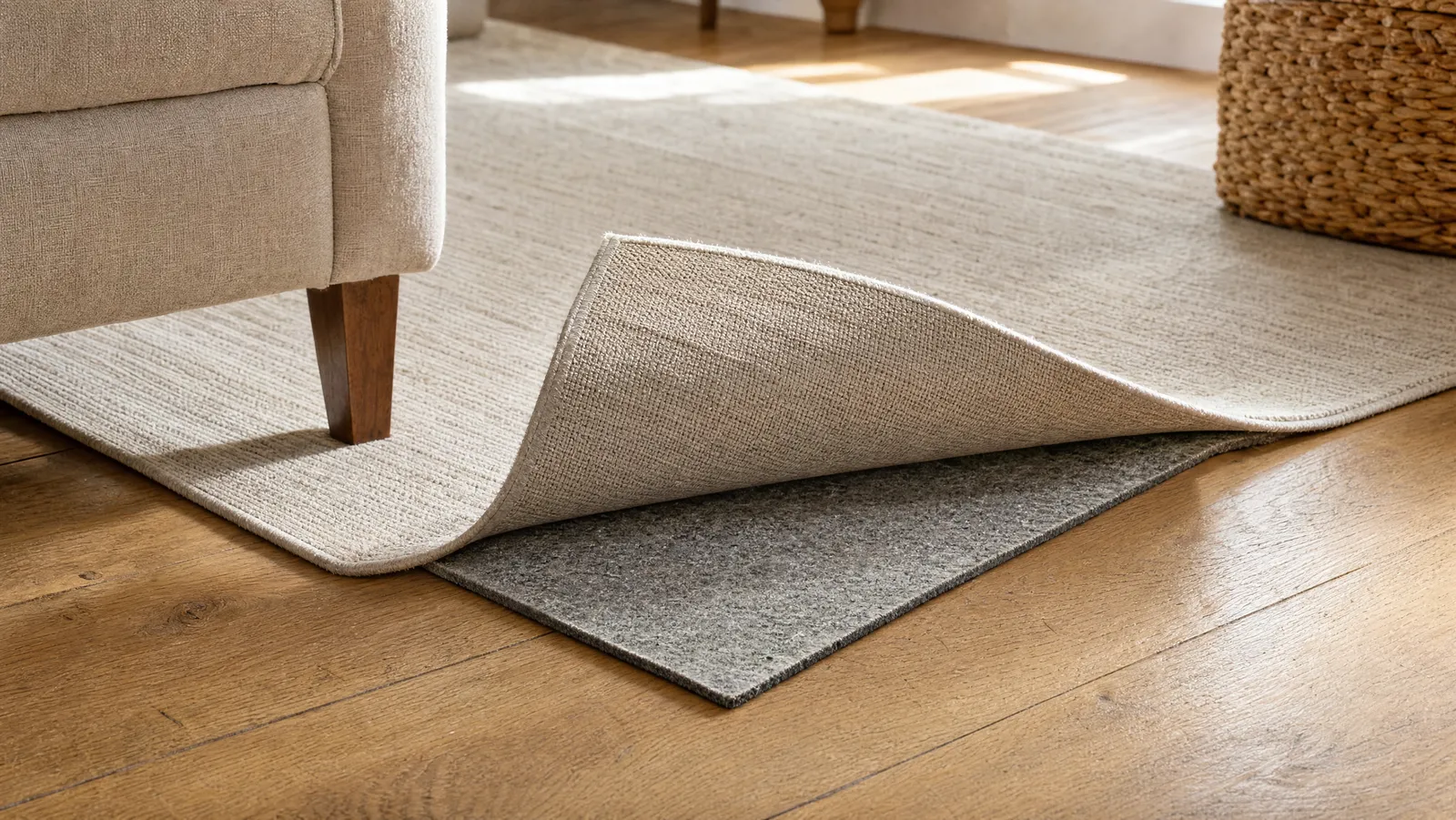
- Pad under the base, always. On hardwood, a felt-and-rubber pad is the standard choice: rubber grips the floor, felt cushions and protects the finish. On tile, a rubber pad grips both surfaces. On carpet, use the carpet-to-carpet type.
- Between the layers, friction usually does the job — a jute or sisal base is grabby enough to hold a flatweave in place, especially with furniture on top. If the top rug still walks, a thin non-slip pad or a few strips of double-sided rug tape between the layers fixes it. The common guidance is to tape all four corners first, then every 12 inches along any edge that still lifts, and to expect to replace the tape periodically — rug tape adhesive is commonly cited as lasting about six months, less in a hot or humid room.
- Treat curling corners at the fiber, not just with weight. According to Atlanta Designer Rugs, gentle heat and moisture relax the fibers so they lie back down: hold a garment steamer or a steam iron about six inches above the surface, without letting it touch the pile, and steam each curled edge for 30 to 60 seconds. The same guide suggests reverse-rolling the rug face-out for 24 to 48 hours, and parking steady furniture legs on the spots that keep lifting. A stack of books, by contrast, tends to be too little weight to hold a curl for long.
- Keep heavy legs off the hem itself. A sofa foot parked directly on the bound edge of the top rug can crush the binding and leave a permanent ripple — weight belongs on the field of the rug, not its border.
Mistakes That Make Layered Rugs Look Cheap
- Rugs too close in size. According to designers quoted by Yahoo Lifestyle, this is the single most common layering error: when the two rugs are nearly the same size, you lose the decorative effect entirely, because neither one stands out from the other. Their fix is the same two-thirds ceiling — keep a healthy margin around the top rug.
- Two thick rugs. The most common thickness guidance we found is to keep both layers under about half an inch. Stack two plush rugs and you get a poofy, unstable mound that bulges at the seams and trips people.
- Two loud patterns. One busy rug, one quiet rug. Always.
- A top rug that touches nothing. Floating in open floor with no furniture on it, a top layer reads as a bath mat that wandered in.
- An uneven border. Eighteen inches of base on one side and four on the other is the fastest way to make a deliberate technique look like a mistake. Measure it; do not eyeball it.
- Layering to avoid buying the right size. If your base rug is too small for the room, adding a second rug does not fix the proportion problem — it just adds a second rug to a room with a proportion problem.
Layered Rug FAQ
What size should the top rug be?
Roughly two-thirds the size of the base at most, and small enough to leave 12 to 18 inches of base showing on every side. On an 8x10 base, a 5x7 is the safe choice; on a 9x12, a 5x8 or 6x9.
Do I need a rug pad if I am layering?
Yes, under the base. Between the layers you often do not — a jute or sisal base grips a flatweave well on its own — but add a thin non-slip pad or rug tape if the top layer moves.
Can you layer two rugs of the same size?
Not successfully in the same spot. Same-size rugs read as one badly aligned rug. If you own two rugs of equal size, put them in adjacent zones instead of stacking them.
Can you layer a rug on carpet in a rental?
Yes, and it is one of the best uses of the technique. Choose a flat-woven top rug, contrast it clearly with the carpet, and use a pad rated for carpet-to-carpet use so it does not creep or discolor the carpet underneath.
What goes on top of a jute rug?
A vintage or vintage-style wool rug, a flatweave or kilim, a hide, or a sheepskin. All four are thin enough not to bulge and different enough in texture to make the layering visible.
The Short Version
Buy the base at full room size, keep both layers thin, make the top rug decisively smaller — 12 to 18 inches of base visible per side is the number to hold — and put furniture on top so nothing drifts. Contrast on texture and pattern, share one color, and keep the border even.
Layering is a finishing move, not a foundation. It works when the base rug is the right rug for the room to begin with, which is a separate question with its own answers — if you are not sure yours is, our full guide to picking an area rug covers sizing, material, and construction before you stack anything on top of it.
The Author
About the author
Interior Designer
Donald Martin
Designer since 2006 and a lifelong lover of rescued objects, Donald Martin knows how to give a second life to pieces and weave them into an eclectic, personalized interior. He writes about decorating real homes on a real budget.