Floor Lamps · 23 min read
How to Choose a Floor Lamp: The Complete Buyer's Guide
 Donald Martin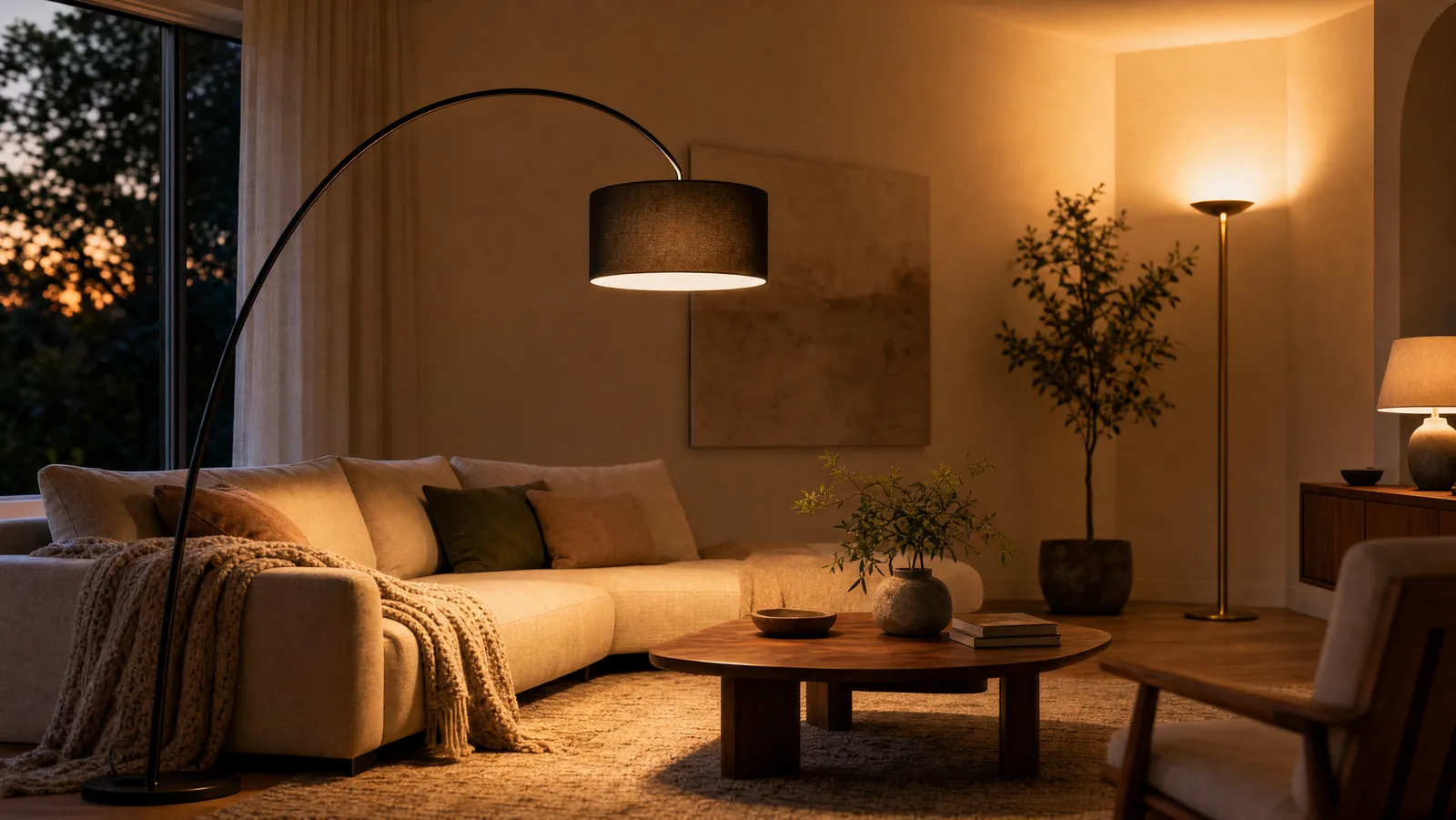
Choose a floor lamp by height first. For a lamp beside a sofa or a reading chair, 58 to 64 inches is the band that works, with the bottom of the shade at or above your eye level when you are seated so the bulb never shines straight at your face. Brightness comes second, color temperature third, style last.
Some links below are affiliate links; if you buy through them we may earn a small commission at no extra cost to you.
That order is the whole trick, and almost nobody follows it. Most people shop a floor lamp the way they shop a poster: find a shape you like, order it, then discover the shade sits at eye height and glares at everyone on the sofa. Learning how to choose a floor lamp is really learning four numbers — height in inches, output in lumens, color temperature in Kelvin, and the width of the base.
This guide takes those in order, then covers placement, dark rooms, and when a table lamp wins. At the end we name six lamps we would buy and what each is for. To browse by look instead of spec, our floor lamp roundup is the visual version of this page.
The Short Answer
- Height: 58 to 64 inches beside a sofa or chair, with the bottom of the shade at or above your seated eye level. A torchiere that aims light at the ceiling can run 70 to 72 inches, because nothing is in your sightline anyway.
- Brightness: shop lumens, not watts. A single floor lamp in a living room corner does its job at roughly 800 to 1,500 lumens. A lamp that is the only light in a dark room needs to be closer to 3,000.
- Color temperature: 2700K to 3000K everywhere you relax. Save 4000K and above for a desk, a craft table or a workshop. Adjustable lamps let you have both.
- Match the type to the job. Torchiere for ambient fill, arc for light over a sofa with no ceiling wiring, gooseneck or pharmacy arm for reading, shaded column for general glow, LED tube for color and mood.
- Base and cord decide placement. A wide, heavy base and a plan for the cord matter more than any style choice, because a lamp you tiptoe around gets moved to a corner and forgotten.
How Tall Should a Floor Lamp Be?
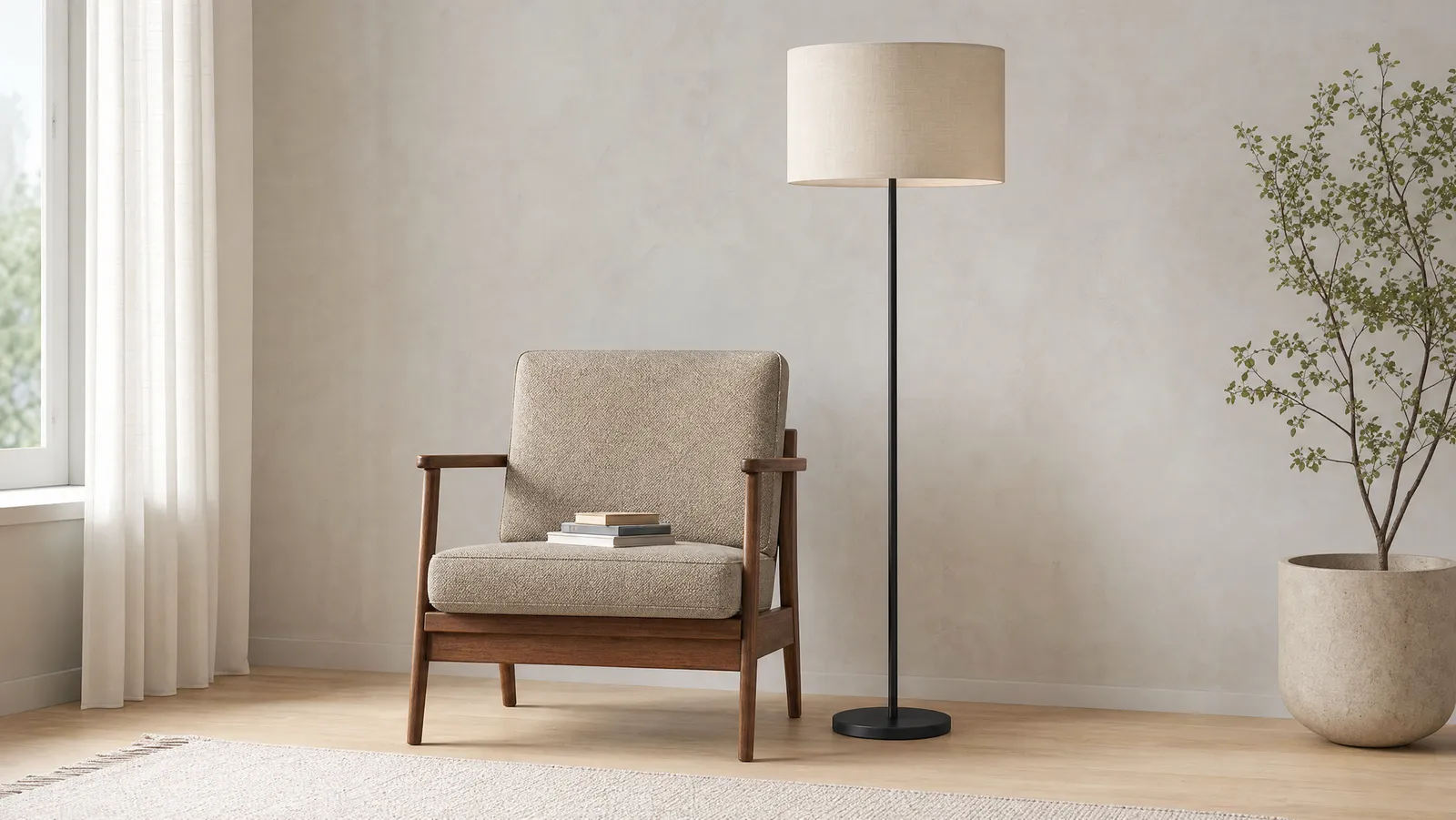
One measurement decides whether a floor lamp works, and it is not printed on the box in bold. The real answer to how tall a floor lamp should be depends on where the bottom edge of the shade lands relative to your eyes when you are sitting down.
So sit down first. Park yourself in the chair or sofa cushion where the lamp will live and have someone measure from the floor up to your eye. That is your line, and the bottom of the shade needs to sit at it or above it. Any lower and you see the bulb, and a naked bulb in your peripheral vision makes a room feel cheap no matter how good the lamp looks switched off.
For most adults in most seating, that lands the lamp at 58 to 64 inches overall. Govee's lighting guide arrives at the same 58 to 64 inch band for a lamp beside a sofa and states the rule plainly: the bottom of the shade should not be lower than the eye level of a seated person.
Three adjustments to that band:
- Ceilings at 10 feet or higher. Lighting guides such as Homebaa's height guide suggest stepping up to 70 to 76 inches so the lamp does not look like it is floating in the lower third of the wall.
- Bedrooms. Govee's guide puts a lamp next to a bed at 55 to 58 inches and one in a bedroom corner at 58 to 60 — short enough to reach from the mattress and less likely to dominate a small room.
- Torchieres. These break the rule on purpose. Because they fire light upward at the ceiling, nothing points at your eyes, so 70 to 72 inches is normal and welcome.
Our picks spread across that range on purpose: the Govee corner lamp is shortest at 53.7 inches, two lamps sit at 60, the SUNMORY is 69, the Ambimall arc is 70, and the Globe Electric torchiere is tallest at 72.
Brightness and Color Temperature
Watts measure electricity consumed. Lumens measure light produced. The two used to track each other closely enough that everyone shopped by wattage, and LEDs broke that habit permanently.
The gap is enormous. The U.S. Energy Information Administration puts incandescent bulbs at roughly 13 to 18 lumens per watt, while LED lamps produce around 83 and ENERGY STAR-qualified models have passed 100. The Department of Energy says residential LEDs use at least 75 percent less energy and last up to 25 times longer than the incandescents they replace. A 9W LED, like the ones bundled with two of our picks, does what a 60W bulb used to.
How many lumens you need depends on room size. The Illuminating Engineering Society's residential recommendations, as summarized by lighting suppliers such as Bees Lighting, put a living room or bedroom at 10 to 20 foot-candles and an ordinary reading area at 20 to 50. Supplier tables vary: Super Bright LEDs lists bedrooms higher, at 20 to 50, and demanding reading and writing at 50 to 100. Turning that into bulbs for your square footage is what our room lighting calculator is for.
As a shortcut, our guide to floor lamp brightness settles on 800 to 1,500 lumens for a lamp adding to existing light and 2,500 to 3,000 for one carrying a room alone. SUNMORY rates its standing lamp at 3,000 lumens; Govee rates its corner lamp at a maximum of 1,000. Two very different jobs.
Color temperature is the other half. Measured in Kelvin, it describes the color of the white light, not the amount. The Department of Energy notes that color-tunable LEDs typically pair warm-white diodes around 2700K with a cool-white set at 5000K to 6500K. Low Kelvin reads yellow and calm, high Kelvin blue-white and alert. Living rooms and bedrooms want 2700K to 3000K, a desk 4000K or more.
One last spec: color rendering index, a 0 to 100 score for how accurately a light shows colors compared with sunlight. Waveform Lighting calls 80 CRI adequate for undemanding spaces and says noticeably great lighting starts at 90, which is what it recommends for the rooms you actually sit in. It is all on the box: the Federal Trade Commission's Lighting Facts label requires brightness, energy cost, life, light appearance in Kelvin and wattage.
Floor Lamp Types Compared
There are five types of floor lamps that account for nearly everything you will see, and each one exists to solve a different problem.
- Torchiere. An upward-facing bowl on a slim pole, usually 70 to 72 inches. It bounces light off the ceiling and spreads it evenly, which makes it the best value in ambient fill. It is also the worst choice for reading, because the light comes from everywhere and lands nowhere.
- Arc. A weighted base with a long curved arm that reaches out over the seating. This is the only floor lamp that puts light where a pendant would go without an electrician. It needs floor space behind or beside the sofa and a base heavy enough to counterweight the reach.
- Task or reading lamp. A gooseneck, swing-arm or pharmacy-style head that aims. Small shade, directed beam, adjustable. Nobody buys one of these for atmosphere.
- Shaded column. A pole, a drum or empire shade, a bulb. The default living-room lamp. It gives soft, diffused light in a circle around itself and asks nothing of the room.
- LED tube and corner lamp. A slim strip or tube, usually app-controlled and color-changing. This is mood lighting and set dressing, not illumination, and it is priced and sized accordingly.
A historical note, because it explains why some people are wary of torchieres. In 1997 the Consumer Product Safety Commission and the lighting industry announced a corrective action covering roughly 40 million halogen torchiere floor lamps, after at least 189 fires and 11 deaths since 1992 tied to extremely hot halogen tubes igniting curtains and clothing. The remedy was a free wire guard and a 300-watt bulb ceiling. That was a halogen problem, not a torchiere problem, and today's LED-compatible torchieres run nowhere near those temperatures. Our Globe Electric pick caps its socket at 150 watts.
Lamps Built for Reading
Reading light is a different specification from room light, and it is where most floor lamps quietly fail. Supplier summaries of Illuminating Engineering Society residential guidance put an ordinary reading area at roughly 20 to 50 foot-candles against 10 to 20 for a living room at rest, and demanding reading and writing as high as 50 to 100. Two to five times the light, aimed at a page the size of a placemat.
Three things separate the best floor lamps for reading from lamps that merely stand near a chair:
- The light aims. A fixed drum shade sprays a circle on the floor. A gooseneck, swing arm or rotating head puts the beam on the page and keeps it out of your eyes.
- The source sits over your shoulder. Behind and slightly to one side of the chair, roughly at or just above seated shoulder height, is the position that lights the page without casting your own hand shadow across it.
- It dims. Reading brightness and evening brightness are not the same, and a lamp that only has one setting will be too much half the time.
The Globe Electric torchiere handles this with brute practicality: a separate adjustable gooseneck reading arm on its own switch, taking a 40W E26 bulb, sitting under a 72-inch torchiere that lights the rest of the room. Two jobs, two switches, one footprint.
The Ambimall arc solves it differently. Its head rotates 350 degrees horizontally and 180 degrees vertically, dims steplessly from 0 to 100 percent, and offers 3000K, 4500K and 6000K, so you can aim cool bright light at a book in the afternoon and warm dim light at the ceiling at ten at night. Its named Immersive Reading preset is just a saved combination of those settings.
If your eyes are older, buy more light than you think you need. Reading guidance scales sharply with age, and the gap between adequate and comfortable is usually one dimmer step.
Where to Put a Floor Lamp
The default position is the one nobody plans: behind and to the outside of a sofa arm or a chair, offset 6 to 12 inches so the shade clears the furniture. From there the lamp lights the seat without standing in front of anything or blocking a view.
Beyond that, placing a floor lamp in a room comes down to four practical checks.
- The corner triangle. A lamp tucked into a corner throws light onto two walls at once, which makes the corner recede and the room read larger. Cheapest square-footage trick in decorating.
- The cord. Find the nearest outlet before you commit to a spot. The Globe Electric torchiere has a five-foot cord, which is typical, and a cord crossing open floor is both a trip hazard and the reason a lamp eventually gets relocated.
- The walkway. Keep the lamp out of the main path. Layout guides commonly cite around 30 to 36 inches for a primary walkway, and a lamp base eating into that will get bumped.
- The rest of the furniture. A lamp beside a sofa has to relate to what is already there. If clearances are still open, our guide to choosing a coffee table covers the distances between sofa, table and walkway that a lamp then has to fit around.
Two placements to avoid: directly opposite a television or a large mirror, where you spend the evening looking at the reflection, and centered on a bare wall, which reads as a lamp waiting for furniture to arrive.
Finally, spread the light out. Designers keep repeating the layered-lighting point in 2026 coverage for a reason: three modest sources at different heights beat one bright fixture overhead, and a floor lamp is the easiest layer to add because it needs no wiring and no permission from a landlord.
Lighting a Dark Room
A dark room is usually not short of lumens. It is short of surfaces to bounce them off, and short of sources.
Start with the ceiling. The single most effective move with floor lamps for dark rooms is a torchiere, because a white or near-white ceiling works as a giant diffuser and returns soft light across the whole room. A 150W-rated torchiere socket filled with a bright LED will do more for a gloomy living room than three shaded lamps in the same corner.
Then add sources rather than wattage. One 3,000-lumen lamp in a corner makes a bright corner and a dark room; three 1,000-lumen sources spread around make an evenly lit one. If you can only afford one lamp, put it in the darkest corner, not next to the window.
The other levers, in the order we would pull them:
- Raise the color temperature slightly. 3000K instead of 2700K can read slightly brighter to the eye at the same lumen count, without tipping into office light. Every adjustable lamp on our list covers both.
- Use a light-colored shade. A dark or opaque shade can absorb a large share of what the bulb produces. Linen, paper and white fabric pass far more of it through.
- Aim at a wall. A rotating head pointed at a pale wall two feet away turns that wall into a second, softer light source.
- Buy the lumens. For a room with one small window, the SUNMORY at a rated 3,000 lumens is a genuinely different class of light from the 9W bulbs included with the two budget-friendly picks.
One caution: brighter is not automatically better after sunset. A room that needs 3,000 lumens at four in the afternoon in January wants a fraction of that at ten at night, which is why dimming matters more in a dark room than a bright one.
Arc Lamps Over a Sofa
An arc lamp is the closest thing to a pendant that does not require an electrician, a ladder or a security deposit. The base sits on the floor behind or beside the seating and the arm curves out and over, dropping light onto the middle of the sofa where a ceiling fixture would put it.
Three things make or break arc floor lamps over a sofa.
- Base weight and width. The arm is a lever, and everything it holds is trying to tip the lamp. Look for an explicitly heavy metal base, which is what Ambimall specifies for its 70-inch arc. A light base under a long reach is a lamp on the floor waiting to happen, especially around pets and children.
- Head clearance. The head should hang above anyone sitting under it, not beside them. Put an arc lamp in a walkway and it clears a seated adult and catches a standing one in the forehead.
- Floor space behind the sofa. The base needs 12 to 18 inches of clear floor plus a cord route. A sofa pushed flat against a wall usually cannot take an arc lamp from behind, only from the end.
Watch the rug edge too. A base parked half on and half off a rug sits at an angle, which is both unstable and visible from across the room. Put the whole base on the rug or keep it entirely off — one more argument for sizing the rug to the seating group first, and our guide to choosing an area rug covers the sizes that let furniture and lamps sit on one plane.
Arc lamps also do something a pendant cannot: they move. If you rearrange the living room every eighteen months, this is the fixture that follows you.
Floor Lamps in the Bedroom
Bedroom lighting has a job the living room does not: helping you stop being awake.
That makes color temperature the first decision. Harvard Health reports that in an experiment comparing 6.5 hours of blue light against green light of comparable brightness, blue light suppressed melatonin for about twice as long, and notes that even around 8 lux — a level most table lamps exceed — can affect circadian rhythm. The practical translation is dull but real: keep evening bedroom light warm and keep it low.
So the best floor lamps for bedrooms share three traits.
- They go to 2700K or 3000K. Every adjustable lamp on this list has a 3000K setting. Use it after dark and save the 5000K and 6500K settings for getting dressed on a winter morning.
- They dim low, not just down a step. Stepless dimming from 0 or 5 percent, as on the Ambimall arc and the SUNMORY, gets you to genuine candle-level light. A three-way switch with low, medium and high does not.
- They are reachable from the bed. Something in the 55 to 60 inch range, or a lamp with a remote. The Ambimall arc's remote is magnetic and sticks to the stand; the SUNMORY's works from up to 50 feet and remembers your last setting, which is the feature you appreciate at 11pm.
Style-wise, a bedroom is where a softer lamp earns its place. The EJIAXIN's fabric drum shade over a candleholder-style column diffuses light instead of throwing a hot spot, and its included bulb drops to 3000K on a rotary switch. The Govee corner lamp is the other bedroom answer entirely — at 1,000 lumens it will not light the room, but as a low amber glow in a corner it is closer to what your body wants at midnight than any overhead fixture.
Floor Lamp or Table Lamp?
These are not competitors so much as answers to different constraints, and the honest test is whether you have a surface.
Here is how we frame choosing between a floor lamp and a table lamp:
- Buy a floor lamp when there is no table. Beside an armchair with nothing next to it, at the end of a sectional, in a corner, behind a sofa that floats in the room. A floor lamp brings its own stand.
- Buy a table lamp when the surface already exists. On a console, a nightstand or an end table, a table lamp adds light without adding a footprint on the floor, and it costs less because it is smaller.
- Floor lamps put light higher. A 60-inch floor lamp lights a wider area than a 26-inch table lamp on a 24-inch table, even at the same lumen output, simply because the source is higher and the spread is broader.
- Table lamps put light closer. For a nightstand, close is the point. You want a small pool of light you can reach without getting up.
- Floor lamps take floor. In a small room where the walkways are already tight, one more base on the floor may be one too many. That is where a table lamp wins on space alone.
Our default in a living room is one floor lamp per seating zone plus a table lamp on any surface that already exists. In a bedroom we would put a table lamp on the nightstand first and add a floor lamp only if there is a reading chair or a genuinely dark corner. And in a room with no side tables at all, the floor lamp is not a preference, it is the only option that works.
Are Floor Lamps Still in Style?
Yes, and more so than five years ago, for a reason that has nothing to do with taste: recessed ceiling lighting turned out to be unflattering, and people noticed.
The 2026 coverage is consistent about where floor lamps have landed. Homedit's 2026 lighting report describes floor lamps moving out of the corner and into the room as sculptural statement pieces, with oversized proportions, geometric-to-organic silhouettes and materials like raw wood, brass and smoked metal — lighting treated as furniture and sculpture at once. Design retailers tracking 2026 trends point to the same shift toward warm metals, aged brass and champagne bronze mixed with matte black, and toward diffused sources such as opal glass and fabric shades over anything that shows a bare bulb.
Underneath the aesthetics is the layered-lighting idea from earlier: rooms built on several lamps at different heights rather than one bright fixture overhead. That is why the floor lamp category keeps growing instead of being absorbed by smart ceiling fixtures.
Which brings us to our take on floor lamp styles for 2026: buy the lamp you would keep in the room if the bulb never turned on. A floor lamp is 5 or 6 feet of vertical object standing in your living room 24 hours a day and lit for maybe five of them. The silhouette is doing most of the work.
Practically: skip anything with a visible plastic seam or a shade that looks like a shipping constraint, and favor a slim profile in a small room. And do not chase the color-changing tube unless you genuinely want it. RGBIC lighting is a real category with real fans, but it is a mood accessory, not a decorating strategy.
The Floor Lamps We Recommend
Six lamps, six jobs. Prices are what we saw when we sourced them, and Amazon moves them. If none is the look you want, our floor lamp roundup has more shapes at similar prices.
Our pick: Dimmable Arc Floor Lamp with Remote
The Ambimall 70-inch arc lamp is what we would buy for most living rooms, at $41.98 as of September 2026 against a $52.99 list. It does the pendant trick over a sofa without wiring, covers 3000K, 4500K and 6000K, and dims steplessly from 0 to 100 percent, so one lamp handles a reading afternoon and a dim evening. The head rotates 350 degrees horizontally and 180 degrees vertically, Ambimall specifies a heavy metal base to resist tipping, and assembly runs 5 to 10 minutes with no tools.
What it trades away: no lumen figure is published, so you are buying brightness on faith, and the Nightlight, Baby Feeding, Work and Immersive Reading presets are saved settings with names, not extra hardware.
Also good: Torchiere with a Separate Reading Arm
For ambient and reading light from one base, the Globe Electric 72-inch torchiere is the efficient answer at $35.94 as of September 2026. The torchiere head takes one E26 150W bulb on a 3-way low, medium and high dimmable switch and throws it at the ceiling; the gooseneck arm takes one E26 40W bulb and aims at your book. Each has its own switch. It accepts LED, incandescent or halogen bulbs, with LED or incandescent recommended.
What it trades away: bulbs are sold separately and you need two, and the five-foot cord limits where it can go.
Also good: Bright LED Standing Lamp with Remote
For a dark room, the SUNMORY LED standing lamp is the brightest thing here on paper, at $42.99 as of September 2026 against a $49.99 list. SUNMORY rates it at 32W and 3,000 lumens, dimmable from 5 to 100 percent across 3000K to 6000K. It stands 69 inches, the head rotates 350 degrees horizontally and 180 longitudinally, the remote works from 50 feet with memory, and the LED beads are rated for up to 30,000 hours.
What it trades away: an 80-plus color rendering index is ordinary, so wood tones, deep reds and skin read slightly flatter than under a 90-plus source. Bright, efficient, faintly clinical.
Also good: Farmhouse Floor Lamp with Linen Shade
The EJIAXIN 60-inch farmhouse lamp is for people who want the lamp to look like furniture, at $62.97 as of September 2026 against a $79.97 list. It is a candleholder-style column in aged black under a fabric drum shade, carrying design patent D1079101. The included 9W LED bulb switches between 3000K, 4000K and 6500K on a rotary switch that also handles brightness, so there is no dimmer to buy.
What it trades away: the body is molded resin, not solid wood or iron, and 9W behind a fabric shade is a warm pool of light, not room lighting.
Also good: RGBIC Smart Corner Lamp
The Govee RGBIC corner lamp is the mood pick, at $64.99 as of September 2026 against a $99.99 list. It is 53.7 inches with a maximum 1,000 lumens, and Govee describes it as best suited to corners and small spaces. RGBIC means each segment holds a different color, so the tube shows several at once instead of one flat wash, alongside 16 million colors, 85 scene modes and music sync. It runs on Alexa, Google Assistant or the Govee Home app.
What it trades away: everything a reading lamp needs. At 1,000 lumens it is an accent, there is no remote in the box, and it only joins 2.4GHz networks.
Budget pick: Simple 60-Inch Lamp with Beige Shade
If you need a competent lamp and nothing else, the Ambimall 60-inch lamp with a beige shade is $29.99 as of September 2026 against a $33.99 list, bulb included. It is 60 inches tall, the shade is 10.04 inches across and 7.87 inches high, and the base is 8.66 inches. The included 9W LED bulb covers 3000K, 4000K and 5000K, cycled by the same foot pedal that switches it on. The head rotates, so it works angled out from behind a couch.
What it trades away: one 9W bulb is a supporting light, not a primary one, and the 8.66-inch base is the narrowest here, so think twice in a house with a large dog or a small child.
Conclusion
Measure before you shop. Sit where the lamp will go, find your seated eye level, and buy something that puts the bottom of the shade at or above it — 58 to 64 inches for nearly everyone, 70 to 72 if the light aims at the ceiling instead. Then check lumens against room size, and keep the Kelvin at 2700K to 3000K anywhere you intend to relax.
For most living rooms the Dimmable Arc Floor Lamp with Remote is our default: it reaches over the sofa, covers three color temperatures, dims to nothing, and costs $41.98 as of September 2026. Buy the Torchiere with a Separate Reading Arm instead for ambient and task light from one base, the Bright LED Standing Lamp with Remote if the room is genuinely dark, the Farmhouse Floor Lamp with Linen Shade if the lamp has to look like furniture, the RGBIC Smart Corner Lamp if you want color rather than light, and the Simple 60-Inch Lamp with Beige Shade if you just need a good lamp for thirty dollars.
And if you are lighting a whole room rather than one chair, run the numbers first: our room lighting calculator tells you how many lumens the space needs before you buy a lamp that turns out to be half of one.
Explore the full series
- How Tall Should a Floor Lamp Be? A Height and Placement Guide — The shade-height, seated-eye-level and clearance numbers that make a floor lamp fit.
- Best Floor Lamps for Reading: Bright, Adjustable and Glare-Free — Task lamps with the beam control and brightness a reading chair actually needs.
The Author
About the author
Interior Designer
Donald Martin
Designer since 2006 and a lifelong lover of rescued objects, Donald Martin knows how to give a second life to pieces and weave them into an eclectic, personalized interior. He writes about decorating real homes on a real budget.