Floor Lamps · 12 min read
Where to Put a Floor Lamp: Placement Rules for Every Room
 Donald Martin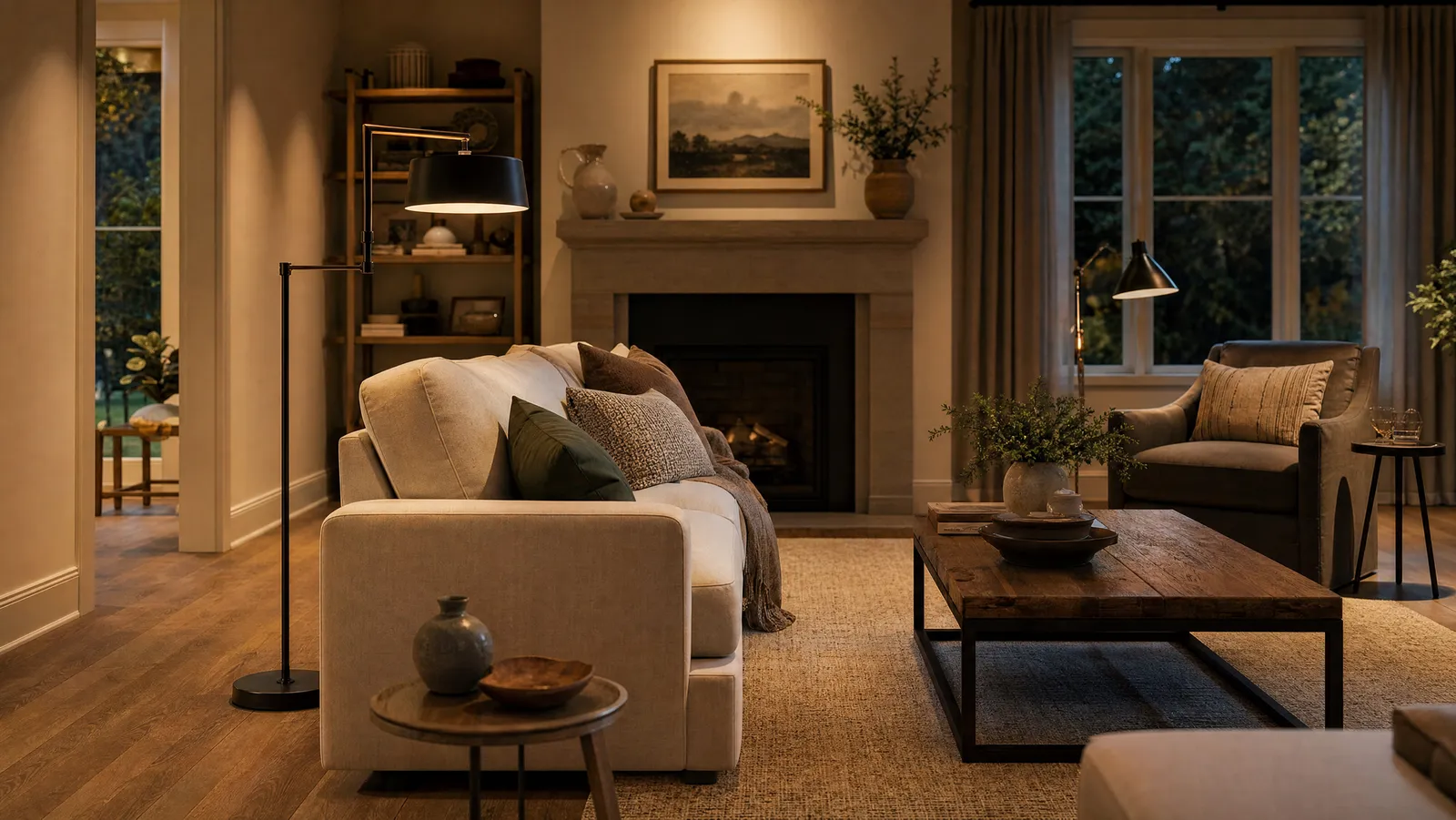
Put a floor lamp beside or slightly behind a seat, at the outer edge of the seating group, on the side of the room away from the window. That one position solves most living rooms. The common mistake is the reverse: stranding the lamp in an empty corner where nobody sits, so it lights a wall instead of a person.
Everything below is that rule broken into measurements. Get a tape measure and find your outlets first. If the lamp is still in a cart, start with how to choose a floor lamp and come back when it is standing in the room.
Three Jobs, Three Placements
A floor lamp is only ever doing one of three jobs, and the job decides the spot.
- Ambient. Filling a room with soft general light. Wants height and a surface to bounce off. Corners, behind seating, anything aimed upward.
- Task. Lighting a page or a laptop. Wants to be close, low, and coming over your shoulder. Beside a chair, never across the room.
- Accent. Washing a plant, a bookcase, a textured wall. Wants an angle and a target. Usually the smallest lamp in the room.
Ask which job before you ask which corner. A torchiere aimed at the ceiling cannot light a book, and a swing-arm reading lamp cannot fill a 14-by-18-foot living room. Our guide to types of floor lamps covers which shape does which job.
The Clearance Numbers for Floor Lamp Placement in a Living Room
Five numbers do most of the work. Where sources disagree, we have given the range.
- 36 inches for a main walkway. VBU Furniture's walkway guide calls 36 inches the standard for a primary living room path and 30 inches the practical minimum in a small room. Below 30, people turn sideways. The lamp base lives outside that lane.
- 24 inches from a doorway. Homebaa's floor lamp placement guide says keep lamps at least 24 inches from doorways and hallway routes. Measure the door swing, not just the opening.
- 8 to 12 inches from furniture. Also Homebaa. That gap is the difference between a lamp you walk past and a lamp you kick.
- 6 to 12 inches from the wall, tightening to 4 to 6 inches in a corner, per the same guide. Closer and an upward-facing shade puts a hot, bright patch on the paint. Further and the base eats the room.
- At least 3 feet from anything that can burn. The U.S. Fire Administration advises keeping lamps, fixtures and bulbs at least 3 feet from anything that can burn, including curtains, bedding and furniture.
Those last two only look like they argue. The 8-to-12-inch gap is about traffic and proportion; the 3-foot rule is a fire clearance for soft things that can drape onto a fixture. If a spot fails any of these, it is the wrong spot.
Beside a Sofa: Which End and How Far From the Arm
Start on the end away from the window. Daylight handles that side by day, and at night you want light where the room is darkest. Set the base 8 to 12 inches off the arm: closer and the shade hovers over the armrest, further and the light lands on the floor instead of the person.
- Sofa against a wall. Lamp at the outside end, in the gap between arm and corner, cord running behind the sofa to the outlet.
- Sofa floating in the room. Put the lamp behind the sofa back instead, with at least 6 inches of clearance per Homebaa. A floating sofa has no wall to hide a cord against, so this is the layout that most often needs a cord cover.
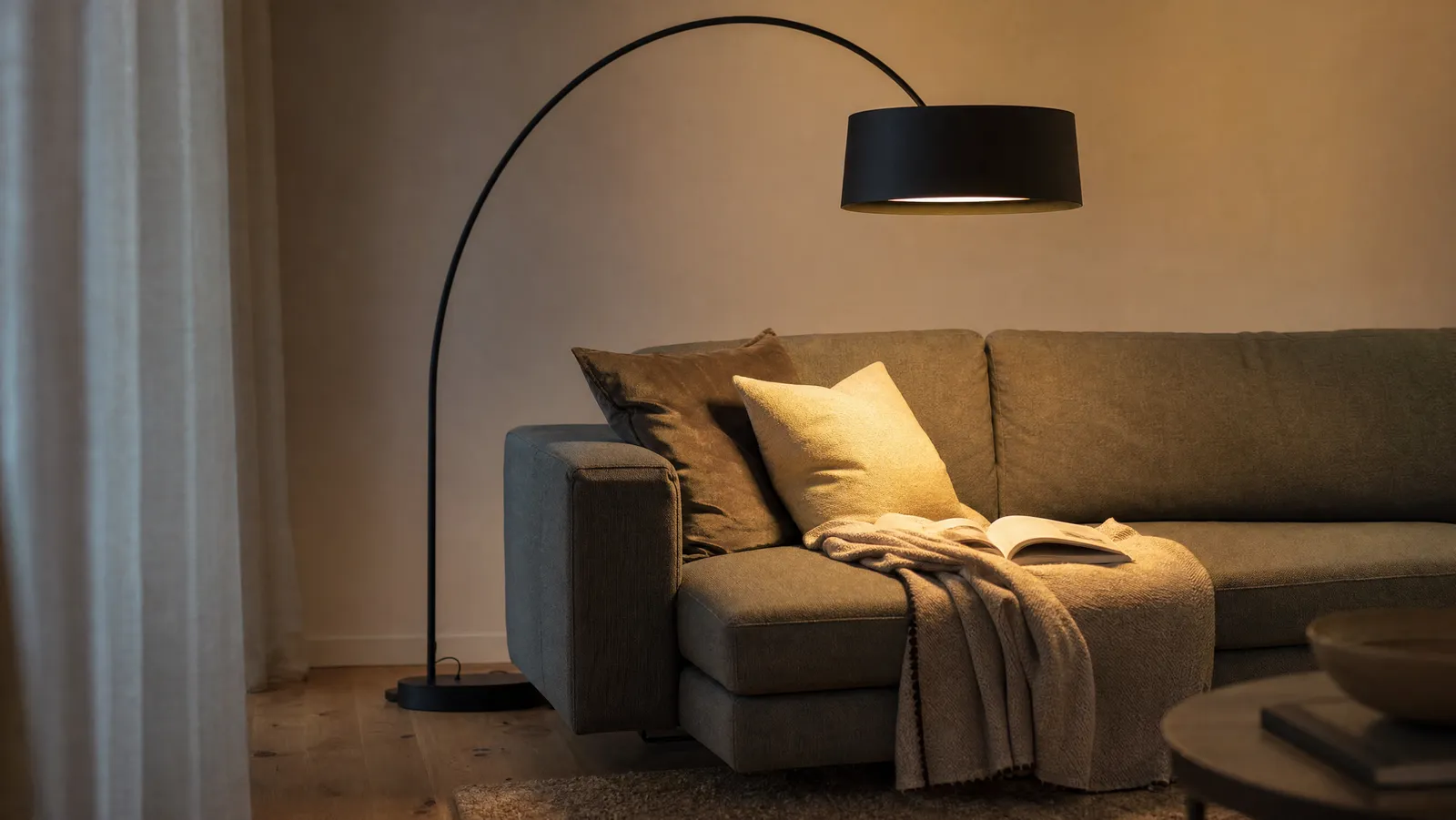
Arc floor lamps over a sofa are a different problem: the base sits well to the side while the shade cantilevers over the seat. That one gets its own guide.
Floor Lamp Behind a Sectional
Sectionals are the hard case: the chaise blocks the corner, the back is longer than any one wall, and the outlet is now behind five feet of upholstery. Work back to front.
- Find the outlet first. Under the National Electrical Code's receptacle spacing rule, no point along a living-area wall's floor line should be more than 6 feet from a receptacle, meaning outlets roughly 12 feet apart on an unbroken wall, as explained in this walkthrough of NEC 210.52. Homebaa agrees from the furniture side: keep the lamp within 6 feet of an outlet.
- Place the lamp at the outside corner of the L, behind the back cushion line. The inside corner where the sections meet is where light goes to die.
- Leave at least 6 inches behind the back, Homebaa's figure, which also gives the cord room.
- Check pole height against the back. Sofa backs commonly run 32 to 36 inches, so a 58-to-64-inch lamp clears one and still drops light over a shoulder.
If the only reachable outlet is on the far wall, do not run a cord across the floor. Buy a longer cord, or move the lamp.
Floor Lamp Next to an Accent Chair or Reading Chair
This placement has a real ergonomic answer, and almost nobody uses it. Light should arrive over your shoulder, from the side opposite your dominant hand. Niori's reading-light guide puts the lamp to the side and slightly behind the shoulder, light hitting the page at roughly a 30 to 45 degree angle, on the non-dominant side so your writing hand casts no shadow across the text. It puts the lamp 18 to 24 inches from the page.
Homebaa gives the floor-plan version: 15 to 20 inches from the seat edge for a reading chair, and 10 to 15 inches to the side and slightly behind where you sit.
The other half is vertical. The bottom of the shade belongs at or just below your seated eye level, the subject of our floor lamp height guide. Get the plan right and the height wrong and you are still staring into a bulb. Measure the chair first, since seat heights swing several inches by style, as our accent chair guide covers.
Floor Lamp Corner Placement: When a Corner Earns a Lamp
There is a long-standing guideline, and we have repeated it ourselves in our roundup of eye-catching floor lamps: place a floor lamp about two-thirds of the way into a room from the entrance, so it lights the path people walk. Fine default for an empty room. Not a rule, and it ignores the two things that matter.
A corner earns a lamp when it bounces light back into the room. Two walls meeting at 90 degrees are a free reflector. An uplight 4 to 6 inches off each wall, per Homebaa, throws light onto both surfaces and back across the floor, the cheapest way to brighten a dim room. Our guide to the best floor lamps for dark rooms covers which lamps do it best.
A corner wastes a lamp when nobody looks at it. The corner behind a door, the one hidden by a bookcase, the one facing away from every seat. The wall glows and nobody reads better for it.
So the test is not distance from the entrance. From the chair you actually sit in, can you see the surfaces that corner lights? If not, move it.
Bedrooms: Beside the Bed or in the Nook
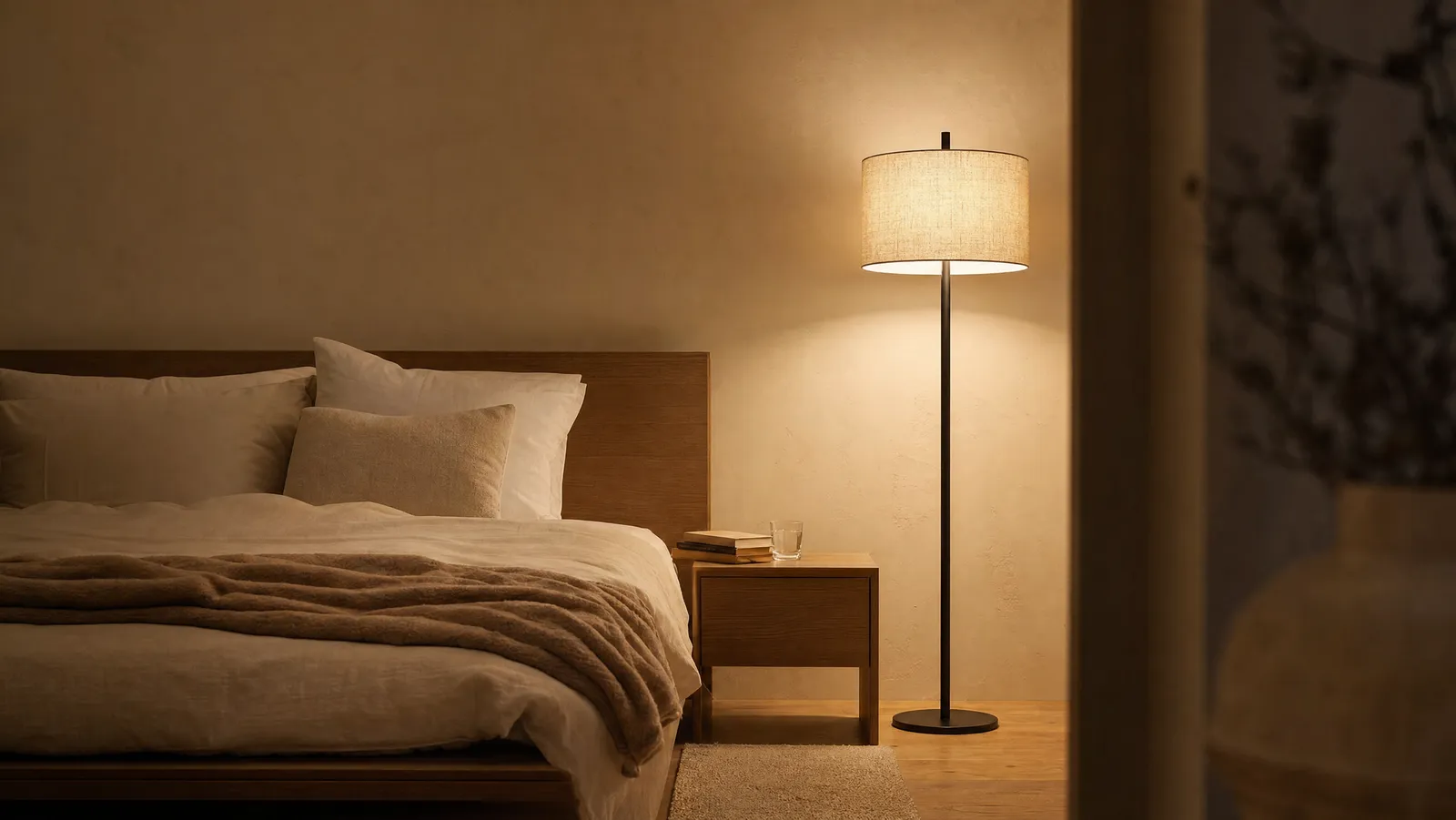
In a small bedroom we would take a floor lamp over a bedside table lamp, and the reason is surface area. A nightstand top is often only 16 to 20 inches across, and a table lamp eats most of it. A floor lamp eats none.
Homebaa suggests about 6 inches between the base and the mattress edge. Keep the shade behind the plane of your head when you sit up, so the bulb never enters your sightline. The U.S. Fire Administration's 3-foot clearance applies squarely to bedding and curtains. A reading nook is easier: treat it like the accent chair above, because it is one.
Behind a TV: Bias Lighting Without Glare
A floor lamp behind a television is doing a job called bias lighting: a soft glow on the wall so your eyes are not switching between a bright picture and a black room. Two numbers make it work.
- 6500K, the D65 white point. SMPTE's Recommended Practice 166 for critical viewing asks that the ambient light in the room sit as close to CIE D65 as possible, which is roughly 6500K and the same white point video is mastered against; MediaLight's bias lighting explainer makes the same case for a D65 reference behind the screen. A warm 2700K lamp behind a screen tints the picture.
- No more than about 10 percent of the screen's peak brightness. DeckTok's rundown of bias lighting standards cites the Imaging Science Foundation guideline that bias lighting should be no more than 10 percent of a display's maximum brightness: enough to see the wall, dim enough that you never look at it instead of the show.
One rule carries no number: the lamp must sit outside the viewing cone. If you can see the shade, the bulb, or a reflection of either in the screen from your seat, it is wrong. Keep the shade below the top of the TV and sit down to check.
Dining Rooms and Entryways
Both come down to circulation.
Dining rooms. A floor lamp is not the overhead fixture and should not try to be. Put it in a corner or behind a sideboard, outside the zone where chairs pull out, and keep VBU's 36-inch walkway clear.
Entryways. A slim lamp beside a console gives light at the door without wiring anything. Keep it at least 24 inches from the doorway, per Homebaa, and pick a weighted base: entryways are where bags get dropped.
Small Rooms and Rentals With No Overhead Light
Plenty of apartments have a living room with no ceiling fixture at all, just a switched outlet. A floor lamp is the fix, and there you plan for coverage, not a feature.
Homebaa suggests roughly one floor lamp per 100 square feet and 8 to 10 feet between lamps in open rooms, so a 200-square-foot living room wants two, set at opposite diagonal corners of the seating group. A torchiere aimed at the ceiling turns the whole ceiling into a fixture, which is as close as you will get to the overhead light you do not have. Our room lighting calculator estimates the lumens a room of your size needs.
Outlets and Floor Lamp Cord Management
This is the section that saves the placement. A perfect spot 11 feet from an outlet is not a spot.
Plan the lamp around the outlet, not the reverse. The NEC receptacle rule above exists because a standard lamp cord is about 6 feet long. Walk the room, mark every receptacle, then choose among the positions a cord can actually reach.
Do not run the cord under a rug. This is a safety claim, not a style preference. Guidance from the Electrical Safety Foundation International is not to place power cords or extension cords in high-traffic areas or under carpets, rugs or furniture, since a covered cord cannot shed heat and foot traffic abrades the insulation. State Farm's extension cord safety guidance says the same: do not run extension cords under rugs or furniture, and keep cords visible rather than strung across a high-traffic route. If your layout drops a lamp mid-rug, move the lamp to the rug's edge or rethink the area rug position itself.
Use a cord cover, not tape. A low-profile cord cover or wall raceway keeps the cord flat, visible and ventilated. ESFI also warns against nailing or stapling cords, which damages the insulation.
Buy the long cord. Lamp cords commonly run 5 to 6 feet. If your sofa floats or your sectional swallows a wall, cord length is a spec worth checking before you buy.
A Five-Step Placement Walkthrough
- Name the job. Ambient, task or accent. It rules out most of the room immediately.
- Sit in the seat. Not the doorway. Note where you read, where the screen is, and where the darkest part of your view falls.
- Mark the outlets. Walk the perimeter and cross off any spot more than 6 feet from a receptacle.
- Tape the footprint. Painter's tape where the base goes. Measure 8 to 12 inches to the nearest furniture, 6 to 12 inches to the wall, 24 inches to the doorway, 36 inches across the main walkway. Walk the route three times.
- Check the sightline. Turn the other lights off. From your seat you should see lit surfaces and no bulb. If the bulb shows, raise the shade, turn the lamp, or move it back a foot.
Frequently Asked Questions
Should a floor lamp go behind or beside a sofa?
Beside, if the sofa is against a wall. Behind, if it floats. Beside puts the light 8 to 12 inches off the arm, where it lands on a reader's lap. Behind needs at least 6 inches of clearance from the back per Homebaa, and a lamp tall enough to clear a 32-to-36-inch back, which any 58-to-64-inch lamp manages.
Can you put a floor lamp in front of a window?
You can, but it is usually the weakest spot in the room. A window returns no reflected light at night, adds glare by day, and the lamp blocks the view. With floor-length curtains, the U.S. Fire Administration's 3-foot clearance applies directly. We would take the opposite wall.
How far should a floor lamp be from a sofa or chair?
For general use, 8 to 12 inches from the furniture. For reading, Homebaa narrows it to 15 to 20 inches from the seat edge and 10 to 15 inches to the side and slightly behind you; Niori puts the lamp 18 to 24 inches from the page.
How many floor lamps does a living room need?
Roughly one per 100 square feet by Homebaa's guideline. A 250-square-foot living room with no overhead fixture wants two or three light sources, and they need not all be floor lamps.
Start With the Seat, Not the Corner
Every rule here collapses into one habit: place the lamp for the person sitting down, then check the clearances, then check the cord. The corner is where a lamp goes when nobody has decided what it is for.
Measure 36 inches across the walkway, 8 to 12 inches off the furniture, 24 inches from the doorway. Keep the cord out from under the rug, then sit down and confirm you cannot see the bulb.
If your lamp keeps failing those tests, the problem may be the lamp. Our guide to choosing the right floor lamp covers height, shade, bulb and switch type, where most bad placements begin.
The Author
About the author
Interior Designer
Donald Martin
Designer since 2006 and a lifelong lover of rescued objects, Donald Martin knows how to give a second life to pieces and weave them into an eclectic, personalized interior. He writes about decorating real homes on a real budget.