Floor Lamps · 11 min read
Types of Floor Lamps Compared: Torchiere, Arc, Tripod and Task
 Donald Martin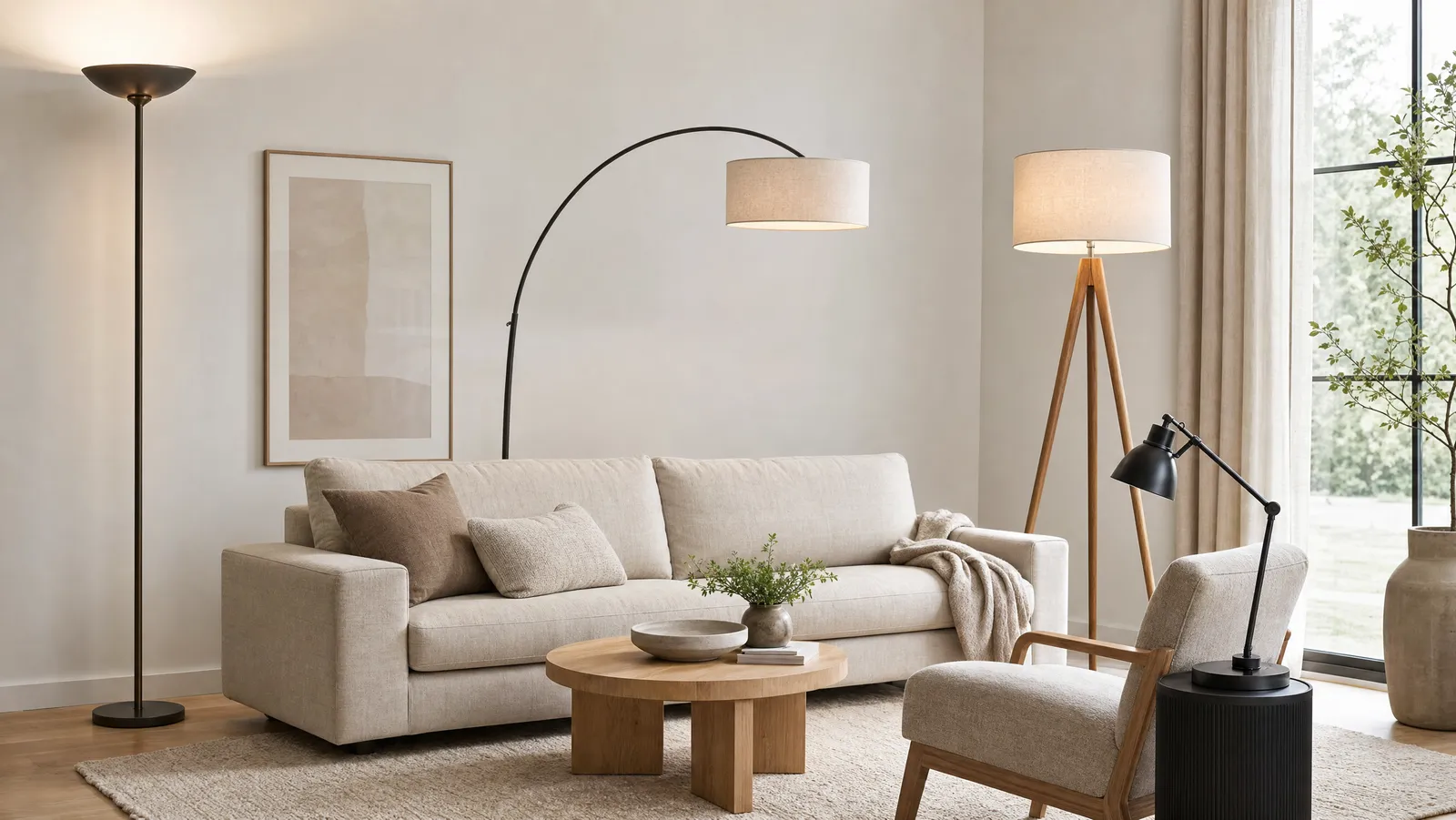
The main types of floor lamps are the torchiere or uplighter, the arc lamp, the tripod lamp, the task or pharmacy lamp, the club lamp with a traditional shade, the multi-head tree lamp, and the tray or shelf lamp. They differ less in style than in aim. A torchiere throws light up, a pharmacy lamp throws it down, and a club lamp does both.
Hold onto that, because it is the whole decision: a type name is really a description of where the light goes. Up, down, or out. Ask what your room is missing, in those terms, and most of this list eliminates itself. Style follows that answer. It does not lead it.
Every type below gets the same five points in the same order, so you can compare them. For the wider decision, including bulbs, switches and shades, start with our guide to choosing a floor lamp.
Torchiere and Uplighter Floor Lamps
- What it is. A tall pole with a bowl or trough shade pointing at the ceiling. Sold as a torchiere, uplighter, uplight lamp or torch lamp. Wikipedia's entry notes the form began as a candelabra stand.
- Which way the light goes. Straight up, then back down off the ceiling as soft, shadowless light. Nothing shines at your eyes, which is why a torchiere makes a room feel lit rather than spot-lit.
- Best for. A living room or bedroom with no ceiling fixture, a pale eight-to-nine-foot ceiling and a corner to spare. The cheapest way to add a whole layer of general light.
- Watch out for. Your ceiling does half the work, so its color decides the result. According to PacLights, a white ceiling at roughly 80 to 90 percent reflectance returns most of the light, while a ceiling below 20 percent reflectance absorbs much of it and needs more powerful lamps to reach the same level. A charcoal ceiling, heavy beams or a tall vault swallows the effect, so budget for that bounce loss when you shop output, as we explain in floor lamp lumens and color temperature. Buying second-hand, note the halogen-era fire record: in a 1997 announcement the US Consumer Product Safety Commission said it knew of at least 189 fires and 11 deaths since 1992 involving halogen torchiere lamps, and advised consumers to use halogen bulbs of 300 watts or less. We would only buy LED.
- Typical height. Lume Art Gallery's torchiere guide recommends 65 to 75 inches total, says anything under 60 inches lacks the vertical throw to wash a ceiling, and puts the minimum gap between bowl and ceiling at 18 inches.
Arc Floor Lamps
The type that puts light where there is no wiring.
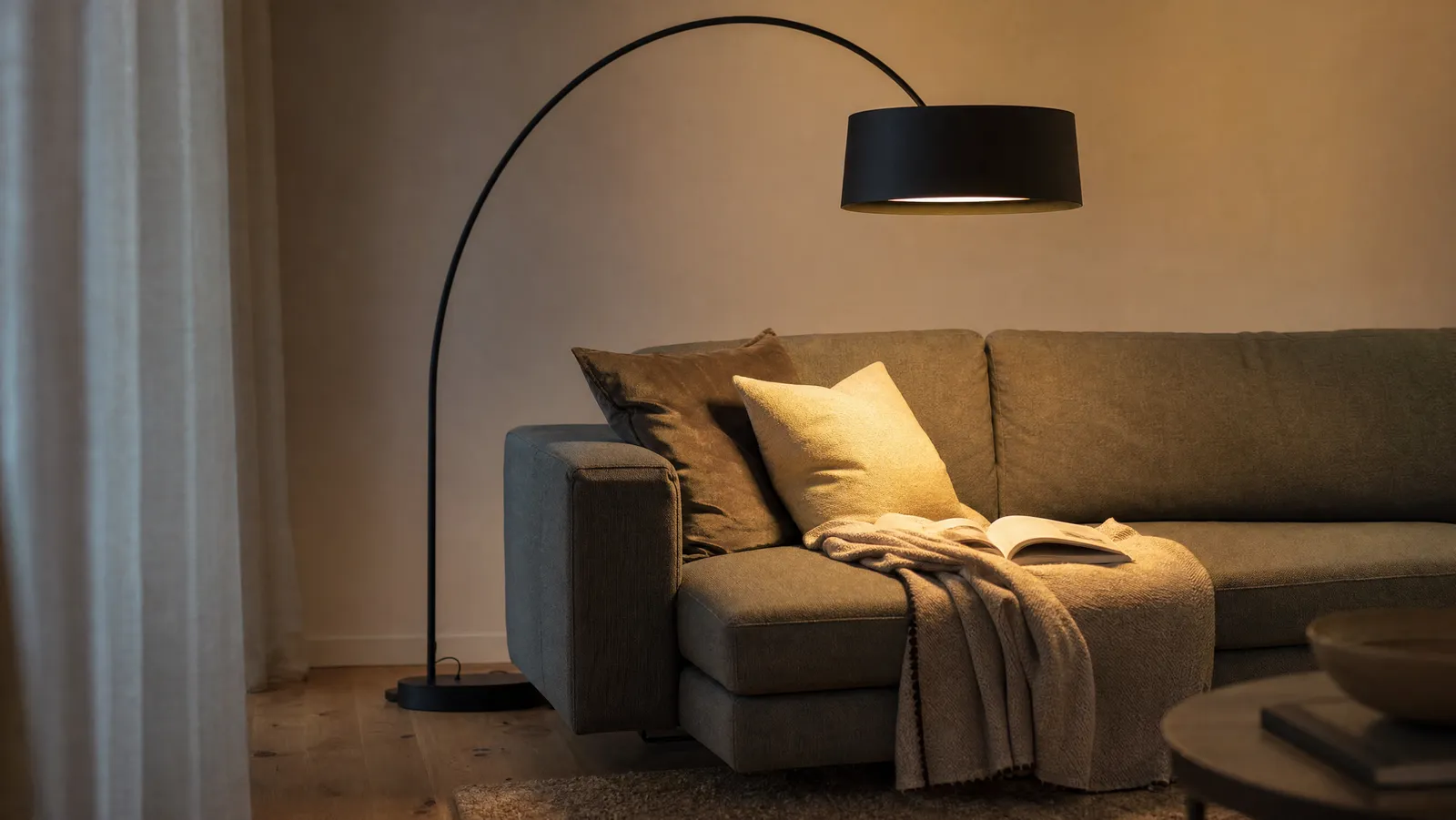
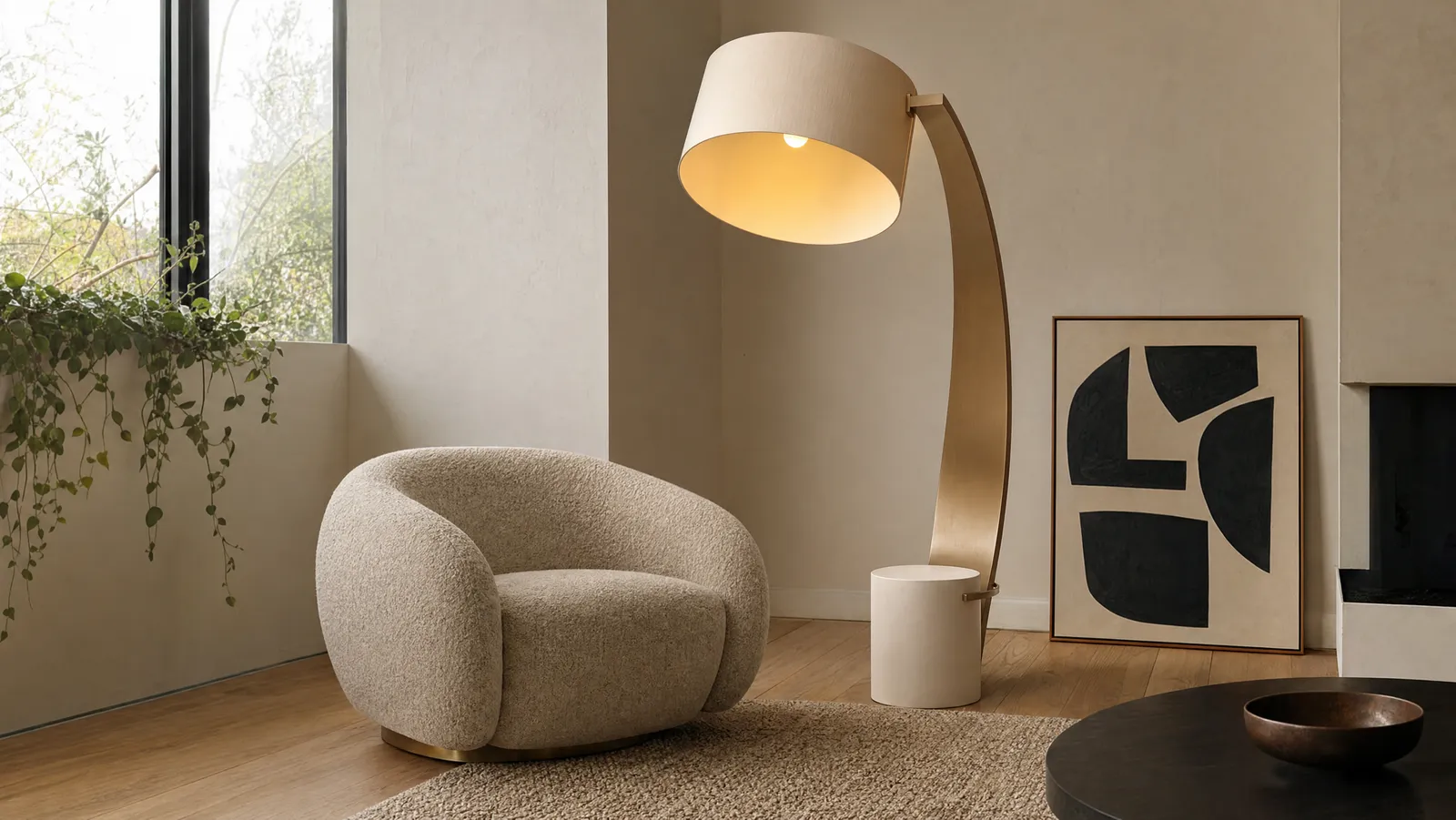
- What it is. A weighted base with a long curved arm that carries the shade several feet away, so the light lands in the middle of the room and the base does not.
- Which way the light goes. Down from height, onto a defined pool. Functionally it is a pendant you can plug in and move.
- Best for. A seating area or dining table with no junction box overhead, and rentals where you cannot touch the ceiling. It is the standard workaround for arc floor lamps over a sofa.
- Watch out for. The counterweight. That base is not a detail, it is the engineering problem, and it needs clear floor outside your walking path. Brightech's spec for a marble-base arc lamp lists a 15-inch slab, two inches thick, and 50 pounds total, reaching 19 inches out.
- Typical reach and footprint. Reach runs from about 19 inches on compact models to the full span of the classic Italian design, which Dimensions.com lists at 95 inches tall, 78.75 inches long overall and 75 pounds. A mid-size example from Archiology is 67 inches tall and 43.3 inches long at 28.6 pounds overall, suited to eight-to-nine-foot ceilings. Measure the arc horizontally before vertically.
Tripod Floor Lamps
- What it is. A three-leg splayed base, usually wood or metal, under a straight pole and a drum or cone shade. Mid-century and industrial versions dominate.
- Which way the light goes. Up and down at once through an open-ended drum: a wash on the ceiling, a pool on the floor, a glow through the fabric in between.
- Best for. Rooms where the lamp is decoration as much as utility. A tripod fills an empty corner visually in a way a slim pole never will, which is why so many pieces in our floor lamp roundup have three legs.
- Watch out for. Floor space. The legs eat a triangle of it, collide with sofa arms and radiators, and a splayed leg in a walkway is a real trip hazard. Most sources advise keeping tripods in corners for that reason.
- Typical height and footprint. Homeyfad's floor lamp height guide puts tripods in the 55-to-65-inch range and points out that the three legs cover more floor than a standard pole lamp. Retail listings commonly show leg spans of roughly 18 to 24 inches across, so treat two feet of clear floor as the planning number.
Task and Pharmacy Floor Lamps
The one type that is not trying to light your room.
- What it is. A small dome or cylinder head on a slim pole with a swing arm. The pharmacy lamp is the classic version: utilitarian, brass or black, adjustable in height and angle.
- Which way the light goes. Down, in a tight beam, onto whatever you point it at. The narrowness is the feature. It lights the page without lighting the person next to you.
- Best for. A reading chair, a craft table, a bedroom corner where one person reads late. More on the picks in best floor lamps for reading.
- Watch out for. It will not light a room, and buying one expecting that is the most common mistake with this type. Pointed at a screen it throws reflections, so aim it over your shoulder, not across your desk.
- Typical height. Pharmacy lamp listings at Wayfair and other retailers commonly adjust between about 47 and 55 inches, with a 360-degree swing arm and a swivel head, though taller listings adjust through roughly 54 to 63 inches. On output, Sunmory's layered lighting guide puts task light at 350 to 500 lumens, a fraction of what a whole room needs.
Club and Traditional Shaded Floor Lamps
The default, and often the right answer.
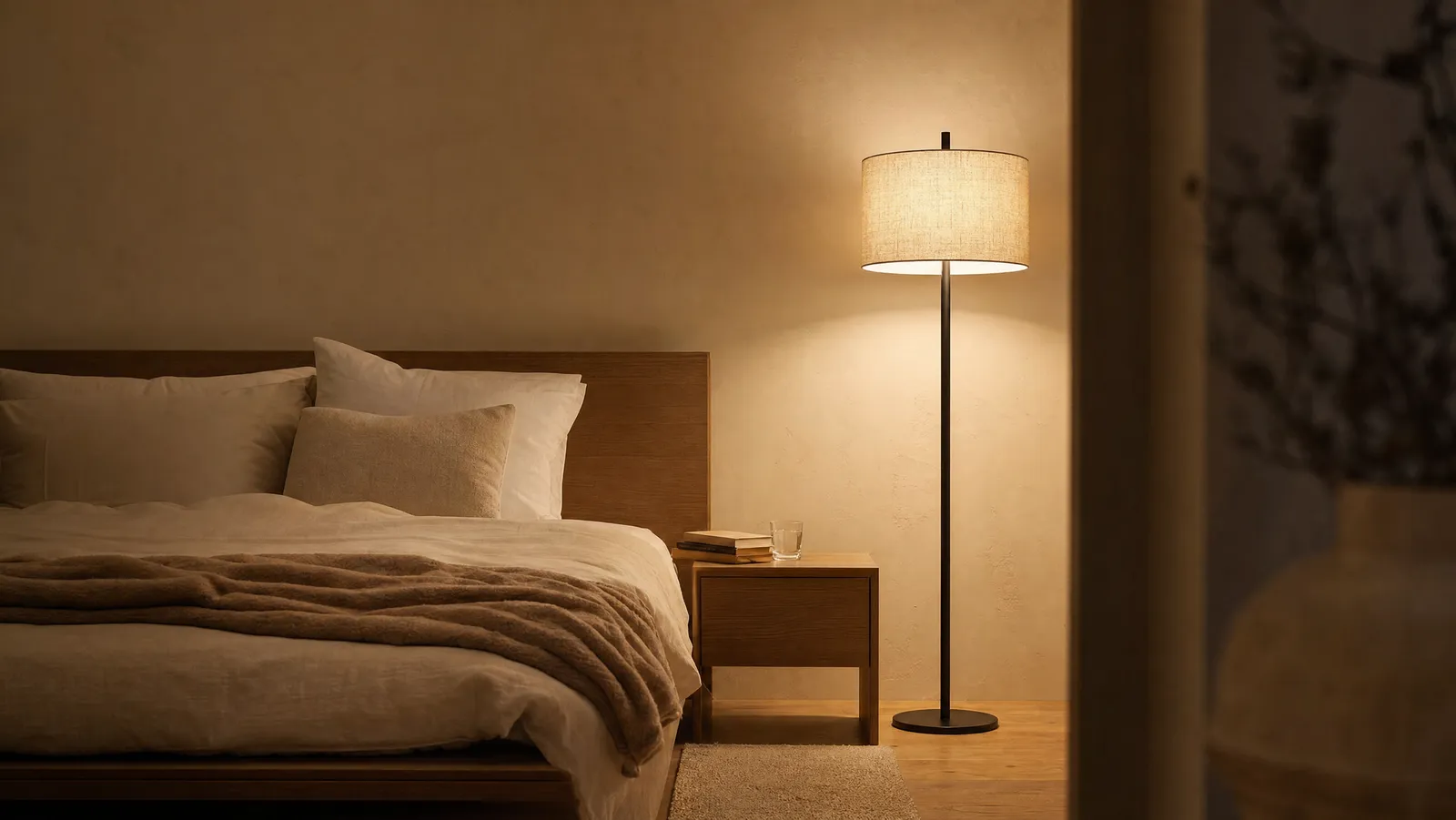
- What it is. A straight pole and a fabric drum, empire or coolie shade. Sometimes called a standard lamp, particularly in British listings.
- Which way the light goes. Up and down through the open ends of the shade, with the fabric killing sideways glare. The most balanced type, because it does a little of everything.
- Best for. Beside a sofa or armchair, as the everyday reading-plus-ambient lamp. If you are buying one lamp for one room, buy this.
- Watch out for. Shade position, which decides whether the lamp is comfortable or unbearable. Too low and you see the bulb. Too high and the light passes over your head onto the wall. The measurements are in our guide to floor lamp height.
- Typical height. According to Govee's height guide, most floor lamps fall between 58 and 64 inches, and for a seated reader the light source should sit just above seated eye level, which Govee puts at 48 to 54 inches off the floor.
Multi-Head and Tree Floor Lamps
- What it is. A pole carrying two to five independently adjustable heads, usually on gooseneck or ball-joint arms. Also sold as a tree lamp or multi-way lamp.
- Which way the light goes. Wherever you point each head. Brightech's multi-head range puts it plainly: aim one at your book, one at the sofa, one at a piece of wall art.
- Best for. A dark room with one usable outlet, or a corner serving both a reader and the room. The highest light-per-square-foot type here, which is why it turns up in our picks for best floor lamps for dark rooms.
- Watch out for. It reads functional rather than decorative, so give it a corner. Check the switching too: on cheaper models every head shares one switch, which throws away the flexibility you paid for.
- Typical height. Retail listings put three-head tree lamps at roughly 66 to 72 inches, with heads that rotate through most of a circle and tilt around 90 degrees. Per-head brightness is usually modest, so read total lumens rather than counting heads.
Tray and Shelf Floor Lamps
- What it is. A standard shaded lamp with a small table, tray or shelf built into the pole, sometimes with a drawer below.
- Which way the light goes. Up and down, like a club lamp. The lighting behavior is ordinary. The furniture is the reason to buy it.
- Best for. Small rooms, apartments and any armchair with no space for a side table. It solves a floor-plan problem, not a lighting one.
- Watch out for. The tray is small, usually wide enough for a mug, a phone and a paperback, and fixed at the height the maker chose. It also pins the lamp to where you want the surface, not where you want the light.
- Typical height. Retail listings run most tray-table lamps between roughly 57 and 65 inches, with the tray near armrest height. Measure your chair arm first, because a tray two inches off is awkward to use.
A Quick Way to Pick
Match your situation to the type and stop there.
- No overhead light at all. Torchiere, or a multi-head if the corners are dark too.
- A dedicated reading chair. Task or pharmacy lamp. Arc if you want light from above and behind.
- A sofa or table floating away from the walls. Arc lamp, with clear floor for the base.
- An empty corner that looks bare. Tripod, or a club lamp with a generous shade.
- A chair with nowhere to put a mug. Tray or shelf lamp.
- A dark or vaulted ceiling. Anything except a torchiere.
Mixing Types in One Room
One ambient source plus one task source beats two of the same thing, every time. Two club lamps at opposite ends of a sofa give you one flat level of light. A torchiere plus a pharmacy lamp gives you a soft room to sit in, a bright pool to read in, and a choice between them.
The numbers back the layering. Sunmory's layered lighting guide puts a standard living room at 1,500 to 3,000 lumens of ambient light, task light at 350 to 500 lumens, accent light at about three times the surrounding ambient level, and recommends three to five separate sources per room at 2700K to 3000K.
In practice that means a ceiling fixture or torchiere for ambient, a task or club lamp beside the seat you actually use, and something small for accent. Where each one stands matters as much as which type you bought, so pair this with where to put a floor lamp before committing to a corner.
One rule we would not bend: put ambient and task lamps on separate switches. A room with one switch has one mood.
Frequently Asked Questions
What is the difference between a torchiere and a standard floor lamp?
Direction. A torchiere has a bowl shade pointing up and bounces all of its light off the ceiling, so the room is lit indirectly and nothing glares. A standard or club lamp has a fabric shade open at both ends and throws light up and down at once: better for reading, worse for filling a room evenly. Torchieres also run taller, 65 to 75 inches per Lume Art Gallery against the usual 58 to 64.
Are tripod floor lamps stable?
Generally yes. Three points sit flat even on an uneven floor, which is why camera tripods use the same geometry. The risk is not tipping, it is tripping: with legs spanning roughly 18 to 24 inches, a tripod in a walkway catches feet and vacuum cleaners. Put it in a corner, and check the base weight if you have pets or small children.
Which type of floor lamp gives the most light?
For filling a whole room, a torchiere or a multi-head, because both spread output widely instead of concentrating it. For light on one surface, a task or pharmacy lamp wins easily, since none of its output is wasted on the walls. A torchiere does lose a real share of its lumens to the ceiling, so it needs more raw output than the box number suggests.
Can one floor lamp replace a ceiling light?
In a small or medium room, often yes, if it is a torchiere or multi-head with enough lumens behind it. In anything larger, one lamp leaves the far corners dark, and Sunmory's three-to-five-sources rule is the honest answer.
What We Would Do
Name the gap before you name the type. Stand in the room at night with the lights you already have on and note whether the problem is dim corners, a dark ceiling, or a page you cannot read. That answer points at up, out or down, and the type follows.
Then check the two numbers that decide whether it works in your room: ceiling height for a torchiere, width of clear floor for an arc or a tripod. Both are free to measure and expensive to get wrong. With a shortlist in hand, run it through our full guide to how to choose a floor lamp for the bulb, shade and switch decisions that apply whichever type you land on.
The Author
About the author
Interior Designer
Donald Martin
Designer since 2006 and a lifelong lover of rescued objects, Donald Martin knows how to give a second life to pieces and weave them into an eclectic, personalized interior. He writes about decorating real homes on a real budget.