Coffee Tables · 12 min read
Coffee Table Materials Compared: Wood, Glass, Marble and Metal
 Donald Martin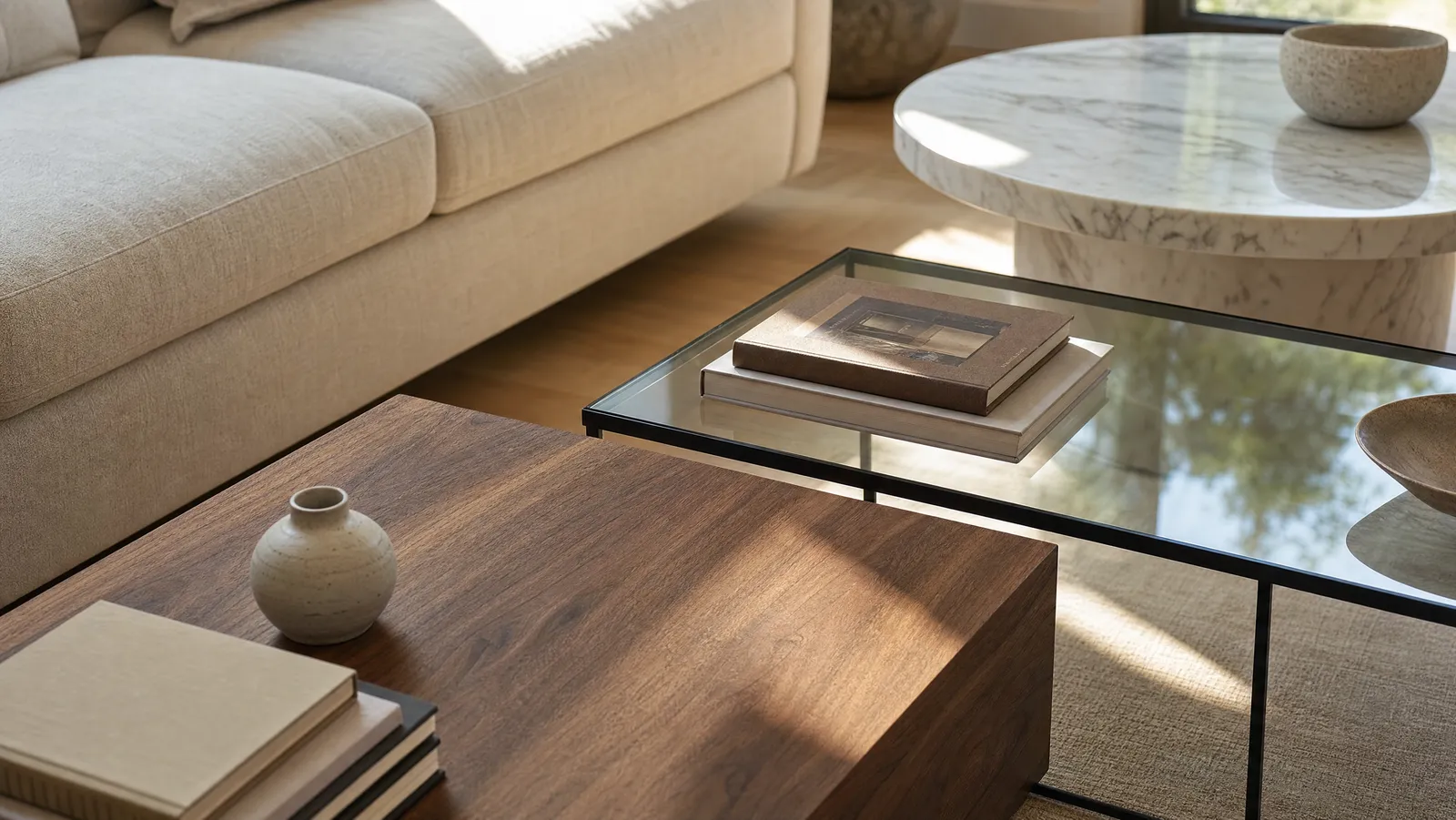
Buy solid hardwood if you want one table for twenty years, tempered glass if the room is small and you want it to feel bigger, and sintered stone if you want the marble look without the chemistry. The variable that decides it is not your mood board. It is who lives in the house: toddlers, dogs, renters, movers.
Coffee table materials differ on four things you feel daily: how the surface handles a sweating glass, how it handles a dropped remote, what it weighs on moving day, and how much attention it wants every week. Everything else is taste. In our guide to how to choose a coffee table we put material third in the buying order, after size and shape, because the room dictates those two. Material is the decision that is genuinely yours.
Below: wood, engineered wood, glass, marble, metal, rattan, concrete and sintered stone — what each survives, what kills it, what it costs to keep — plus a cleaning list and a recommendation by household.
The Short Answer: Match the Material to the Household, Not the Mood Board
The verdict first, evidence after:
- Toddlers or a big dog: solid wood with a soft profile, or an upholstered ottoman with a tray. Not glass.
- Adults only, small room: tempered glass on a slim metal base.
- You eat, drink and work at the table: sintered stone. The best coffee table material for a surface used like a desk is the one that shrugs off acid.
- You move every couple of years: engineered wood, or metal and glass. Weight is the enemy.
- One table, twenty years: solid hardwood, the only common top you can sand back to new.
- You want marble: buy it and accept etch marks as patina, or buy sintered stone and stop worrying. There is no honest third option.
Material and silhouette constrain each other — stone almost never comes as a slim oval, glass is at its best as a circle — so read our guide to coffee table shapes alongside this one.
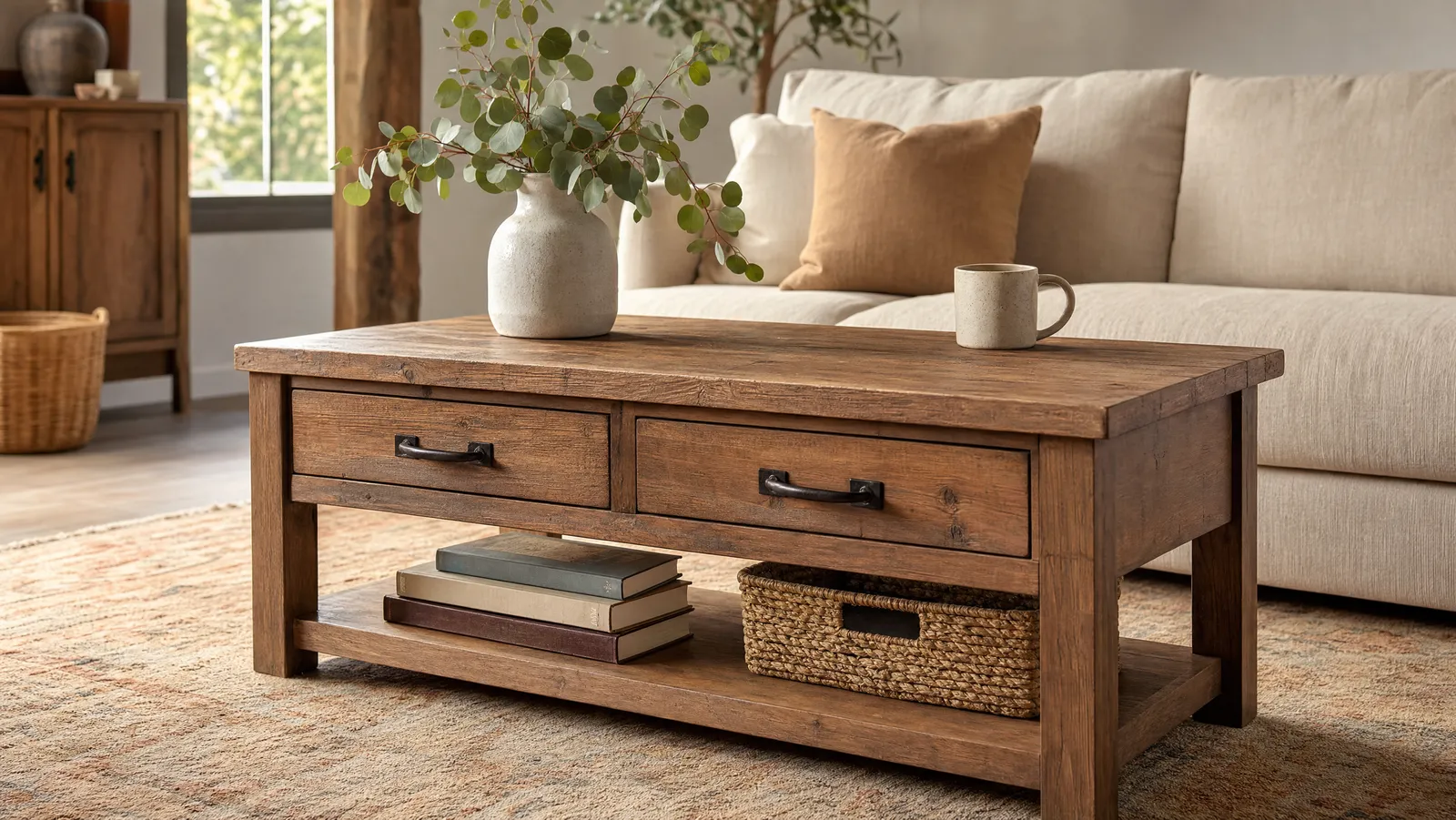
Solid Wood: The Default, and What Solid Actually Means
Solid wood is the default because it is the only mainstream top that gets better with damage. Dents become the story of the table rather than the end of it, and when you have had enough, you sand it back.
What solid means. Solid wood is real timber all the way through. Veneer, according to iHome Studio's furniture buying guide, is a thin slice of real wood, usually less than three millimetres thick, applied to an MDF or plywood core. Solid wood frame means the legs are timber and the top is something else; plain "wood finish" usually means printed paper. The tell is the edge: on solid wood the grain runs over the top and down the side and matches. On veneer it stops at a seam.
Movement is the trade-off. According to the USDA Forest Products Laboratory's Wood Handbook, wood changes dimension as it gains or loses moisture below the fibre saturation point, and that movement produces warping, checking and splitting. The handbook's chapter on drying and moisture control puts the recommended average moisture content for interior furniture and woodwork at 8 percent across most of the United States, 6 percent in the dry southwestern area and 11 percent in damp, warm coastal areas. A table built humid and shipped dry will move. Good ones allow for it; cheap ones crack.
Refinishing is the whole argument. Per iHome Studio, solid wood can be sanded and refinished multiple times, veneer cannot take heavy sanding without exposing its core, and MDF cannot be refinished at all. That decides most twenty-year purchases.
Engineered Wood, MDF and Veneer: What Most Budget Tables Actually Are
There is no shame in engineered wood, only in paying solid-wood prices for it. Rule of thumb: if a full-size coffee table costs less than a decent pair of shoes, assume MDF or particleboard under a veneer.
MDF. Dense, smooth, stable, and it takes paint better than timber ever will. It has one failure mode. As Willow Bath and Vanity's solid wood versus MDF comparison puts it, MDF is dimensionally stable while sealed but swells irreversibly once water reaches an unsealed edge. On a coffee table those edges are underneath, around screw holes and inside drawer boxes — exactly where a spilled glass runs.
Particleboard. A step down. HomeLane's guide notes that particle board has low resistance to moisture and humidity and expands when it gets wet, and the Forest Products Laboratory's chapter on wood-based composites describes panels made from particles as prone to irreversible thickness swelling once wetted. That soft, bubbled corner on a flat-pack table is this.
Plywood. Underrated. The Wood Handbook credits plywood with excellent dimensional stability along its length and across its width, and says that unlike most panels fabricated from particles it undergoes minimal irreversible thickness swelling if wetted. That is why it is the engineered panel worth paying up for in anything structural.
Where it earns its place: anything with a mechanism. Lift-tops and storage tables need flat, machinable panels that will not move, which is why nearly every one is built this way — see our roundup of lift-top coffee tables and an upcoming guide to the best coffee tables with storage.
Glass Tops: Tempered or Nothing
Glass buys back space. The rug shows through, so the table stops reading as a solid block in the room. Material is one of the few levers you have over apparent bulk once the footprint is fixed, and the numbers behind that footprint are in our guide to coffee table height and size.
The safety rule is not optional. ASTM F2813, which covers glass used as an unenclosed horizontal surface under 44 inches high in a desk or table, requires laminated or tempered safety glass meeting ANSI Z97.1-2009 and does not permit monolithic annealed, chemically strengthened or wired glass. Annealed glass breaks into long blades. Tempered does not: under the federal glazing standard at 16 CFR 1201.2, tempered glass is heat- or chemically-treated glass that cannot be cut or drilled after treatment without fracture, and when fractured at any point, if highly tempered, the whole piece breaks into small particles.
Why that matters for a table you might kick. The injuries are not from dropped mugs. According to an ASTM report on glass in furniture, most serious injuries involving glass in furniture happen when juveniles or elderly adults fall into glass-topped coffee tables. If the listing does not say tempered, assume it is not.
The daily reality is fingerprints. Every touch shows, and the underside collects dust you can see through. Styling is maintenance here: a tray, books and a bowl cover the middle third and halve the smudge patrol, which is why our guide to how to style a coffee table doubles as a cleaning strategy.
Know the trade-offs: cold, loud, and edge chips are permanent.
Marble and Stone: Beautiful, Heavy, and Chemically Fragile
Marble is calcium carbonate, and that one fact explains every complaint about it.
Etching is not staining, and sealing does not stop it. A stain soaks in; an etch is a chemical burn where acid has dissolved the surface. As International Stoneworks explains, an etch mark forms when acid, ammonia or alcohol meets the calcium carbonate in the stone, and cleaning will not remove it: polished stone must be re-polished, honed stone re-honed. The Natural Stone Institute is blunt about sealing: the products the industry calls sealers are impregnators that act as a repellent rather than a sealer, and sealing does not make stone stain proof, only more stain resistant. It warns that lemon, vinegar and other acids may dull or etch calcareous stones, and recommends coasters under all glasses, especially those holding alcohol or citrus.
A gin and tonic left on bare marble overnight can leave a dull ring no cleaner will lift. Honed marble hides etching far better than polished, so buy honed.
Weight is the other problem. According to a stone slab weight calculator, marble runs about 11.2 pounds per square foot at 20 millimetres thick and 16.7 pounds at 30 millimetres. A 48-by-24-inch top is 8 square feet, so the slab alone is roughly 90 pounds at 2 centimetres and 134 at 3, before the base. Check the base is engineered for it — a slab on a hollow tube frame fails the day someone sits on the corner — and accept that a stone table does not move without help.
Metal Bases and Metal Tops: Structure First, Surface Second
Metal is usually the base, and that is where it earns its keep: a steel frame allows thin sections wood cannot, so the table looks light while carrying a heavy slab.
Finish is what you are buying. In SendCutSend's surface durability testing, powder-coated steel came out best of the finishes tested, showing only minor scratches and discoloration of the coating with no underlying metal exposed. The caveat is that when damage does go through, it goes to bare steel, and touch-up is visible.
Brass is a different bargain. Unlacquered brass patinates with handling and is meant to; lacquered brass looks perfect until the lacquer wears through at the high-touch spots. Metal tops, meanwhile, show every fingerprint and are cold and loud. Metal is best as a frame under wood, glass or stone, and as stability: a wide weighted base resists the sideways shove that racks a wooden frame over the years.
Rattan, Cane and Woven Tops: Light, Warm and Seasonal
Woven tops give a room texture no flat surface can, and weigh almost nothing. They are also the least durable material here. According to ZM Home's rattan durability guide, natural rattan used indoors typically lasts 10 to 15 years with care and premium pieces 15 to 20, with moisture and direct sunlight its enemies as humidity seeps into the fibres. Care guides from rattan and wicker specialists recommend keeping indoor relative humidity between 30 and 50 percent, and a water-repellent sealant, lacquer or UV-resistant varnish on pieces that see sun or damp.
The practical limit: a woven top is not a surface, it is a support for a tray.
Concrete and Sintered Stone: The Newer Options
Concrete reads industrial and costs less than stone, but it is porous. Concrete Network's guide recommends a water-based penetrating sealer, which makes the concrete less porous and repels most common food and beverage stains, and puts concrete coffee tables anywhere from under 100 dollars to over 1,000. It also flags the fix for weight: glass-fibre-reinforced concrete, or GFRC, is as much as 75 percent lighter than standard concrete and more crack resistant. Restoration Hardware's care sheet says to avoid acidic substances including wine, coffee, fruit juice, salad dressing, olive oil and tomato sauce, because they damage the sealer. Concrete has marble's chemistry problem at a lower price.
Sintered stone is mineral powder fused under heat and pressure. According to Paramount Stone's sintered stone versus marble comparison, it rates 7 to 8 on the Mohs scale against marble's 3.0, absorbs 0.1 percent water or less against marble's typical 0.8 to 1.0 percent, and is fired above 1,000 degrees Celsius, while marble discolours under high heat. The same guide prices marble material at roughly 29.92 to 74.80 pounds per square foot and sintered stone at 48.62 to 112.21, so performance carries a premium.
The catch: hardness cuts both ways. Sintered surfaces can chip at an unsupported edge, and a chip is not repairable the way an etch is.
Care and Cleaning by Material
- Solid wood. Soft dry cloth, wipe spills immediately, keep humidity stable, coasters always. Oiled finishes want re-oiling once or twice a year; lacquered ones want leaving alone.
- Veneer and MDF. Damp cloth only, dried straight away, and keep water off the edges and screw holes where the irreversible swelling starts.
- Glass. Cleaner on a microfibre cloth rather than sprayed at the surface, so nothing runs into the frame. Underside monthly.
- Marble. A neutral cleaner, stone soap or mild dishwashing detergent in warm water, per the Natural Stone Institute, which also warns off scouring powders and creams because their abrasives can scratch stone. No vinegar, no lemon. Reseal on schedule, knowing it buys stain resistance and not etch resistance.
- Concrete. Blot immediately, mild non-acidic cleaner, re-seal when water stops beading.
- Sintered stone. Soap and water. That is the pitch.
- Metal. Dry-dust powder coat; on brass, polish it or let it patina, not both.
- Rattan and cane. Vacuum the weave with a brush head, wipe barely damp, keep out of direct sun.
Same logic as the floor, as in our comparison of rug materials: a material is not good or bad, it is priced for the attention it asks for.
Which Coffee Table Material We Would Choose
By household, with no hedging:
- Family with toddlers: solid wood, heavy, with rounded edges. No glass, no stone corners, nothing light enough to drag. An ottoman with a hard tray removes the edge entirely.
- Dogs and cats: solid wood or sintered stone. Tails never leave glass fingerprint-free and claws find rattan immediately; wood hides scratches best because it already has grain.
- Renters who move often: glass on a metal base, or engineered wood. A 90-pound stone top is a moving-day problem you pay for twice.
- Small or dark rooms: tempered glass, ideally round — the only material that returns floor space to the eye. Second choice, pale wood on a slim metal base.
- You cook and entertain on the table: sintered stone. Non-porous, acid-indifferent, heat-tolerant, and it costs what low maintenance costs.
- Buy it for life: solid hardwood. Everything else here ages toward replacement; wood ages toward refinishing.
When two conflict, let the household win over the room. A material that suits your square footage but not your dog is one you will resent.
The Bottom Line
There is no best coffee table material in the abstract, only one that matches how your household treats a horizontal surface. Solid wood absorbs abuse and can be reset. Engineered wood buys cheap, mechanism-friendly panels at the price of one bad spill. Glass costs fingerprints and gives back a small room. Marble is gorgeous and chemically defenceless. Metal is the best base and a mediocre top. Concrete is marble's problems for less money, and sintered stone is the low-maintenance winner that charges accordingly.
Pick the surface that survives the people in your house, then pick the finish you like from that shortlist. Material is one decision among several — size, shape, height and base all interact — and our guide to choosing the right coffee table walks them in order, so the table you buy is one you stop thinking about.
The Author
About the author
Interior Designer
Donald Martin
Designer since 2006 and a lifelong lover of rescued objects, Donald Martin knows how to give a second life to pieces and weave them into an eclectic, personalized interior. He writes about decorating real homes on a real budget.